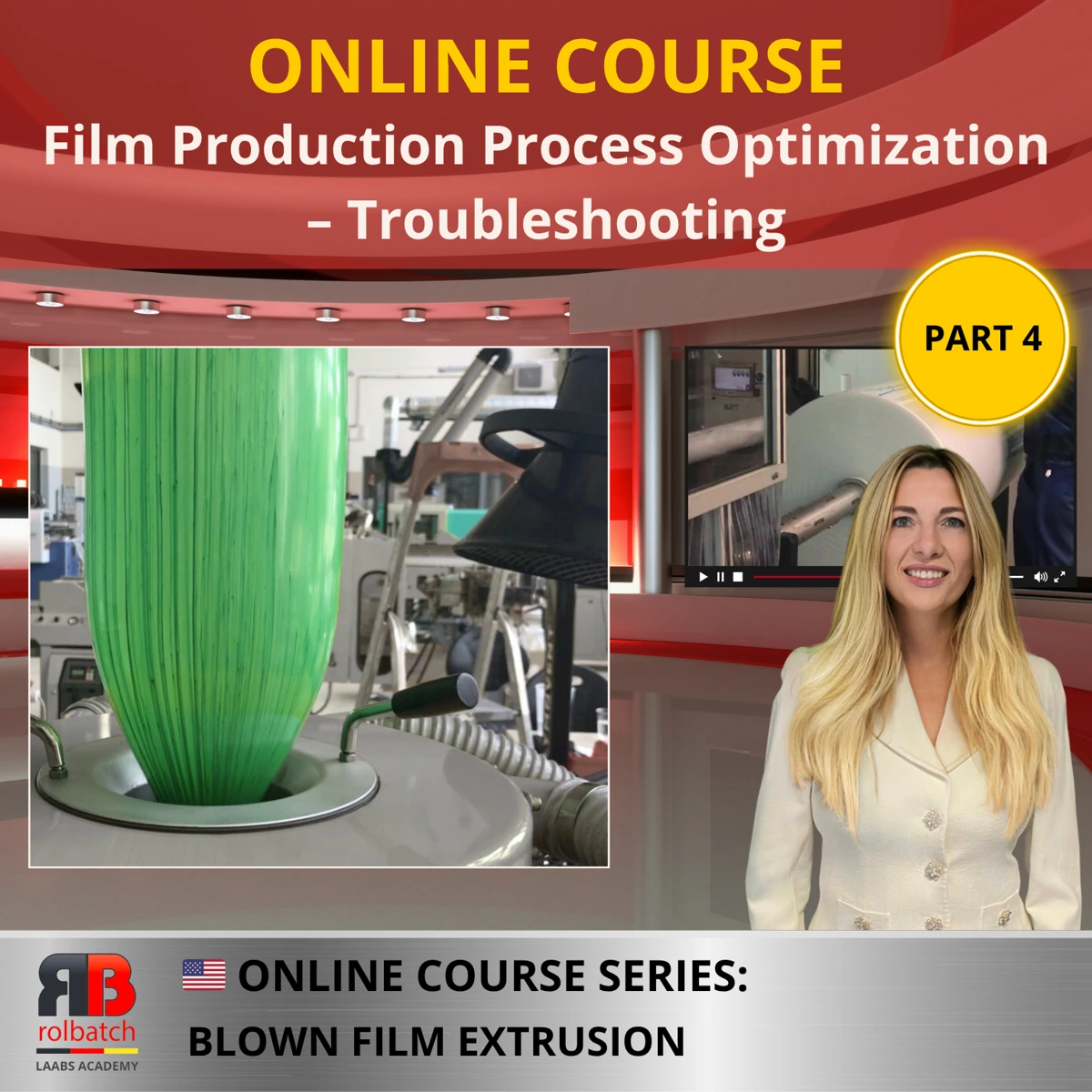
Optimising film production processes: troubleshooting
Identifying the causes of film bubble instability, uneven thickness, surface defects, wrinkles and winding problems. A structured approach to solving production problems.
You can add other courses, Executive and books to one enquiry.
Detailed programme description
Expand the full course descriptionCollapse the full description
Process optimisation and troubleshooting
The course addresses identifying the causes of film defects and unstable line operation. It covers the sequence for checking raw materials, settings and equipment when problems occur with the film bubble, thickness, surface and winding.
Participants learn to analyse a symptom, check possible causes and evaluate the result of a correction. Actions at the machine should take account of the manufacturer's documentation and the plant's safety rules.
Skills developed in the course
- Diagnose the most common film defects: thickness variations, surface defects, film bubble instability and winding problems, and connect each to its root cause
- Distinguish between machine, material and process problems: because the corrective actions are completely different in each case
- Apply a systematic approach: symptom → cause → correction → prevention, instead of trial and error
- Respond faster and more effectively to production problems, taking account of safety rules and assessing whether the line needs to be stopped
- Understand how screw speed, pressure, cooling and temperature interact and how changing one parameter affects the others
- Eliminate recurring winding defects: wrinkling, conical rolls and film sticking, by addressing the actual cause rather than simply changing winder settings
Who is this course for?
- Machine operatorswho face production problems every day but often address symptoms rather than causes
- Production engineers and process engineerswho need a systematic troubleshooting method beyond relying on experience and guesswork
- Quality specialistswho want to connect defects with specific process conditions
- Maintenance teamswho need to distinguish mechanical problems from process problems
- Production managers and plant directorswho want to reduce downtime and waste, and have a team that solves problems instead of repeating them
Detailed topic coverage
The most common film defects and how to eliminate them A structured overview of the problems most frequently encountered on blown film extrusion lines and the diagnostic logic behind each one.
Uneven film thickness What causes thickness variation around the film bubble and in the machine direction, and how to correct it through die and cooling settings and process parameters.
Surface defects: orange peel, streaks and discolouration How to identify whether the cause is temperature, material, contamination or a mechanical factor, and how to proceed in each case.
Film bubble instability: drift, oscillations and collapse How cooling, pressure and melt properties interact to destabilise the film bubble, and how to regain control.
Mechanical damage to film Scratches, deformations and stress marks: where they arise in the process and how to prevent them.
Optimising cooling: avoiding deformation and internal stresses How cooling rate and uniformity affect film structure, flatness and properties in downstream processing.
Screw speed and pressure: their impact on quality How these key parameters affect melt homogeneity, output stability and the final properties of the film.
Rapid correction of process errors during production How to make effective corrections while following safety rules, assessing whether the line needs to be stopped and avoiding new problems.
Winding defects: wrinkling, delamination and conical rolls Why most winding problems do not start at the winder, and how to find their actual source earlier in the process.
Film sticking: why thin film sticks and how to prevent it The role of temperature, additives and process conditions in film blocking and sticking.
Course format
- Practical PDF materials based on real production problems, each analysed using the sequence symptom → cause → correction → prevention
- Video and audio explanations for selected topics: film bubble behaviour, defect identification and practical process adjustment
- Final quiz assessing the ability to diagnose problems and select appropriate actions
A Rolbatch Academy certificate of participation and the opportunity to earn a diploma after a knowledge assessment. The requirements are explained in the FAQ.
This course is the turning point of the series.
Parts 1-3 give your team understanding. Part 4 provides the ability to act in practice. Every subsequent course, covering supporting technologies, multilayer technologies, recycling and cost analysis, builds on the troubleshooting skills developed here.
Learning arrangements and ordering
The course includes PDF materials and video and audio explanations of selected topics. Participants work at their own pace and can revisit the materials during the access period. Completion, certificate and diploma requirements are explained in the FAQ.
Please include the number of participants, language and preferred date in your enquiry. We will confirm availability, the access period and terms for your team. We accept orders by email. You can combine selected parts, Executive and books in one enquiry.
What does this part cover?
- Film bubble instability and uneven thickness.
- Surface defects and film appearance problems.
- Wrinkles, film blocking and winding irregularities.
- Diagnostic sequence: observing the symptom, possible causes and selecting actions.
When should you choose this course?
Choose this part when quality or process stability problems recur at the plant and the team needs a structured approach to identifying their causes.
How do you use the materials?
You learn online and revisit selected topics during the access period. You can choose the course on its own or combine it with other parts of the programme. In the offer, we will confirm the language, activation date, access period and terms for the selected number of participants.
Course knowledge should be applied with reference to the documentation, equipment and working rules of the specific plant.
Course language
Operator courses, Parts 1-9, are available in Polish, English, German and Spanish. The Executive programme is currently available in English only. We prepare other languages, including Italian and Russian, on request. For orders of at least 10 licences for the same course for 10 people, translation into an additional language is included at no extra charge. An additional translation charge applies to smaller groups. We will confirm the preparation timeframe in the offer.
Specify the language in your enquiry