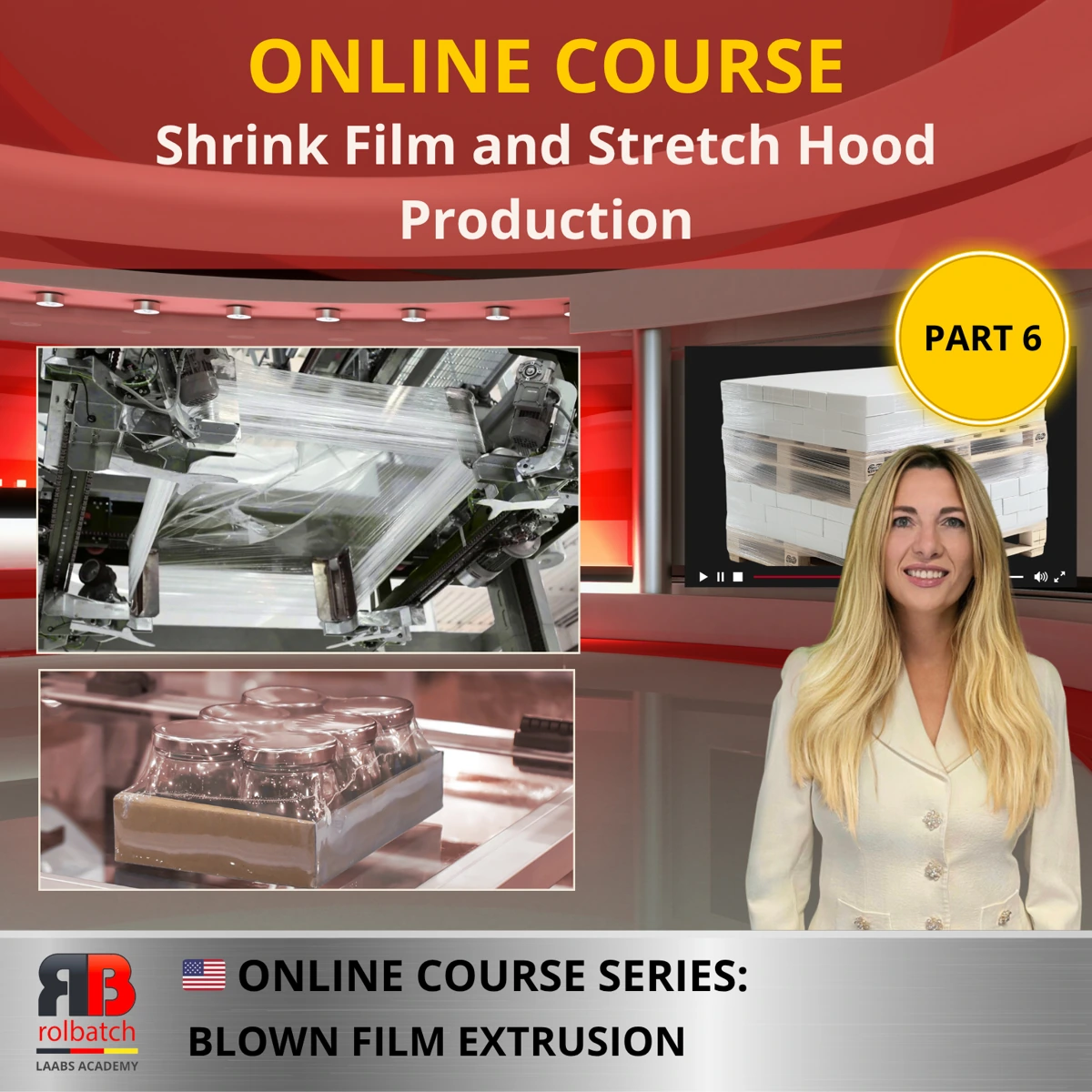
Shrink film and stretch hood production
Selecting raw materials, formulations and parameters to meet shrink film and stretch hood requirements. The relationship between production conditions, shrinkage, elasticity and mechanical properties.
You can add other courses, Executive and books to one enquiry.
Detailed programme description
Expand the full course descriptionCollapse the full description
Shrink film and stretch hood production
The course connects load securing requirements with the selection of raw materials, formulations and production conditions. It covers shrink films and stretch hood films, which differ in how they are applied and stabilise the pallet.
The relationships between stretching, shrinkage, strength and processing conditions are discussed. The material is intended for those responsible for producing and assessing the properties of these films.
Skills developed in the course
- Understand the fundamental difference between shrink film and stretch hood: thermal shrinking versus mechanical stretching and elastic recovery, and why each requires a completely different production approach
- Select appropriate raw materials for shrink film (LDPE, LLDPE and EVA) and understand how each resin affects shrinkage, transparency and processability
- Select appropriate raw materials for stretch hood and understand what determines load stability, puncture resistance and elastic recovery
- Understand how EVA content and additives modify film behaviour during shrinking and when they improve properties or cause problems
- Control film orientation (MD/TD) as a key parameter for shrink direction, uniformity and mechanical strength
- Set process parameters specific to shrink film: temperature, BUR and cooling, and understand how each affects the final shrink result
- Set process parameters specific to stretch hood and understand how they differ from shrink film production
- Maintain film bubble stability with demanding formulations: higher EVA content, specialist blends and their impact on process behaviour
- Understand how cooling rate and uniformity affect the internal structure of the film and its performance properties
- Connect mechanical test results with process conditions: tensile strength, elongation and shrink force, and use them for optimisation as well as reporting
Who is this course for?
- Machine operators producing shrink film or stretch hood who need to understand why the process settings for these films differ from those for standard PE film
- Production engineers and process engineers responsible for formulation, process settings and achieving specified performance properties
- Quality specialistswho need to connect laboratory test results (shrink percentage, tensile strength and puncture resistance) with process conditions and raw material selection
- Production managers and plant directors in companies producing shrink film or stretch hood, or planning to add these products to their range
- Companies receiving complaints about film performance at the customer's site: shrink uniformity, load stability and film failures during application
Detailed topic coverage
Shrink film versus stretch hood: differences in technology and application How each type works, why the production approach is fundamentally different, and what this means for raw material selection, process settings and quality control.
Raw materials for shrink film: LDPE, LLDPE and EVA How each resin type affects shrink behaviour, optical properties and processability, and the trade-offs between transparency, shrink performance and process stability.
Raw materials for stretch hood What determines load holding force, puncture resistance and elastic recovery, and how material selection differs from shrink film.
The role of EVA and additives in shrink films How EVA content and functional additives change the film's response to heat, and when their use improves performance or creates new problems.
Film orientation (MD/TD): the key to shrinkage and strength How process settings control the direction and degree of shrinkage, and why orientation is the most important factor affecting film performance.
Process parameters for shrink film production Temperature profiles, BUR and cooling settings: how each parameter affects the degree of shrinkage, uniformity and final film quality.
Process parameters for stretch hood production How process setup differs from shrink film, and which parameters determine elongation, elastic recovery and load stability.
Film bubble stability with demanding formulations How higher EVA content and specialist blends affect film bubble behaviour, and how to maintain process stability with these materials.
Cooling and its impact on film structure How cooling rate and uniformity affect crystallinity, orientation and the mechanical properties that determine film performance.
Mechanical testing and process optimisation How to use tensile strength, elongation, shrink force and puncture resistance test results to identify problems linked to specific process conditions, and how to solve them.
Course format
- Practical PDF materials structured around the relationships between process settings, raw materials and film performance
- Video and audio explanations for selected topics: orientation behaviour, shrink mechanics and stretch hood application
- Final quiz assessing the ability to connect process decisions with product properties
A Rolbatch Academy certificate of participation and the opportunity to earn a diploma after a knowledge assessment. The requirements are explained in the FAQ.
Learning arrangements and ordering
The course includes PDF materials and video and audio explanations of selected topics. Participants work at their own pace and can revisit the materials during the access period. Completion, certificate and diploma requirements are explained in the FAQ.
Please include the number of participants, language and preferred date in your enquiry. We will confirm availability, the access period and terms for your team. We accept orders by email. You can combine selected parts, Executive and books in one enquiry.
What does this part cover?
- Differences between shrink film and stretch hood film.
- Selecting raw materials and formulations for the film's application.
- The impact of the process on shrinkage, elasticity and strength.
- Connecting film parameters with load securing requirements.
When should you choose this course?
Choose this part when the plant produces shrink films or stretch hood and needs to connect customer requirements with raw materials and production conditions.
How do you use the materials?
You learn online and revisit selected topics during the access period. You can choose the course on its own or combine it with other parts of the programme. In the offer, we will confirm the language, activation date, access period and terms for the selected number of participants.
Course knowledge should be applied with reference to the documentation, equipment and working rules of the specific plant.
Course language
Operator courses, Parts 1-9, are available in Polish, English, German and Spanish. The Executive programme is currently available in English only. We prepare other languages, including Italian and Russian, on request. For orders of at least 10 licences for the same course for 10 people, translation into an additional language is included at no extra charge. An additional translation charge applies to smaller groups. We will confirm the preparation timeframe in the offer.
Specify the language in your enquiry