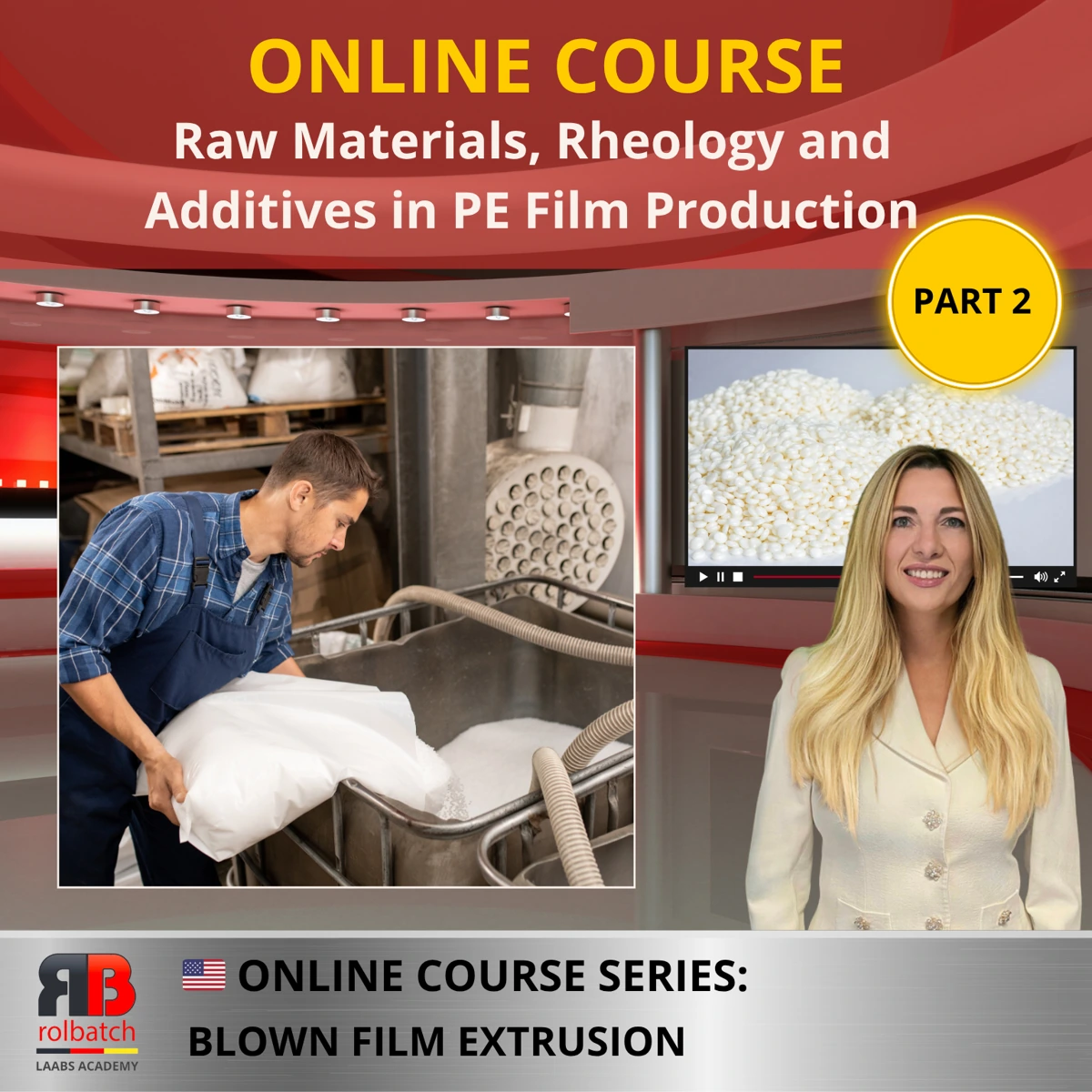
Raw materials, rheology and additives in PE film production
The properties of LDPE, LLDPE, mLLDPE, MDPE and HDPE, and the importance of rheology, additives and regranulate. Relationships between material selection, film bubble stability and product quality.
You can add other courses, Executive and books to one enquiry.
Detailed programme description
Expand the full course descriptionCollapse the full description
Raw materials, rheology and additives in PE film production
The course covers the selection of polymers and additives for blown film production. It connects raw material properties with melt behaviour during extrusion, film bubble stability and product properties.
Particular attention is given to differences between polyethylene grades, batch variability and the interpretation of test results. Participants learn the relationships needed when changing a formulation, supplier or proportion of recycled raw materials.
Skills developed in the course
- How melt viscosity, elasticity and melt strength affect film bubble stability, thickness uniformity and cooling behaviour
- Why LDPE, LLDPE, metallocene LLDPE, MDPE and HDPE behave so differently during film extrusion despite similar datasheet values
- Why metallocene polyethylenes require different processing conditions from conventional LLDPE, and what happens when this is ignored
- How additives (slip agents, antiblocking agents and stabilisers) affect melt behaviour in the barrel and die as well as the properties of the finished film
- How regrind and regranulate change melt rheology and why the same blend can behave differently between batches
- How to make material change decisions based on rheologyinstead of simply compensating for problems with machine settings
Who is this course for?
- Machine operatorswho observe the effects of material changes on the line but do not always know whether the cause is the resin, additives or machine settings
- Production engineers and process engineerswho need to predict how a raw material change will affect the process before introducing it
- Quality specialistswho want to connect laboratory results with actual process behaviour on the line
- Production managerswho need their team to make material decisions based on knowledge rather than trial and error
- Companies introducing new raw materials, blends or regranulate into production
Detailed topic coverage
Polymer melt rheology in film extrusion What rheology means in practice: how melt viscosity, elasticity and melt strength determine film bubble stability, thickness uniformity and cooling behaviour. Why MFI alone is not enough.
Rheological characteristics of polyethylenes used in film extrusion A comparison of LDPE, LLDPE, metallocene LLDPE, MDPE and HDPE: how each behaves differently under shear and extension, and what this means for the process.
How raw material rheology affects film bubble stability and film quality The relationship between melt properties and what you observe on the line: frost line position, thickness variation, mechanical strength and optical properties.
Additives and their impact on melt behaviour How slip agents, antiblocking agents, UV stabilisers and other functional additives affect melt flow in the barrel and die, and the risks of incorrect dosing.
Regrind and regranulate: impact on rheology and process stability Why regrind changes melt properties, why the same blend can behave differently between batches, and how to minimise instability when working with secondary materials.
From rheology to production decisions How to interpret process behaviour when changing raw materials, additives or regrind content, and make decisions based on melt properties rather than guesswork.
Quality control and laboratory results in context Which laboratory tests actually matter for blown film production, and how to connect measurement results with observations on the line.
Course format
- Practical PDF materials covering raw material rheology, additives and process behaviour in the context of real blown film production
- Video and audio explanations for selected topics: melt behaviour, film bubble stability and material comparisons
- Final quiz assessing understanding of key relationships between material, rheology and process
A Rolbatch Academy certificate of participation and the opportunity to earn a diploma after a knowledge assessment. The requirements are explained in the FAQ.
Part 1 gives the team an understanding of process logic. Part 2 provides material logic. Together, they form the foundation for everything that follows: line construction, process optimisation, multilayer technologies and troubleshooting.
Learning arrangements and ordering
The course includes PDF materials and video and audio explanations of selected topics. Participants work at their own pace and can revisit the materials during the access period. Completion, certificate and diploma requirements are explained in the FAQ.
Please include the number of participants, language and preferred date in your enquiry. We will confirm availability, the access period and terms for your team. We accept orders by email. You can combine selected parts, Executive and books in one enquiry.
What does this part cover?
- Differences between LDPE, LLDPE, mLLDPE, MDPE and HDPE.
- The importance of melt viscosity, elasticity and strength.
- Slip, antiblocking and stabilising additives.
- The impact of regranulate and raw material variability on production.
When should you choose this course?
Choose this part when the team needs a better understanding of raw material and additive behaviour, to analyse batch differences or discuss formulations with greater understanding.
How do you use the materials?
You learn online and revisit selected topics during the access period. You can choose the course on its own or combine it with other parts of the programme. In the offer, we will confirm the language, activation date, access period and terms for the selected number of participants.
Course knowledge should be applied with reference to the documentation, equipment and working rules of the specific plant.
Course language
Operator courses, Parts 1-9, are available in Polish, English, German and Spanish. The Executive programme is currently available in English only. We prepare other languages, including Italian and Russian, on request. For orders of at least 10 licences for the same course for 10 people, translation into an additional language is included at no extra charge. An additional translation charge applies to smaller groups. We will confirm the preparation timeframe in the offer.
Specify the language in your enquiry