Film extrusion line construction
The functions of the extruder, screw, die, filtration system, cooling, film bubble stabilisation, haul-off and winder. How individual components affect the process.
You can add other courses, Executive and books to one enquiry.
Detailed programme description
Expand the full course descriptionCollapse the full description
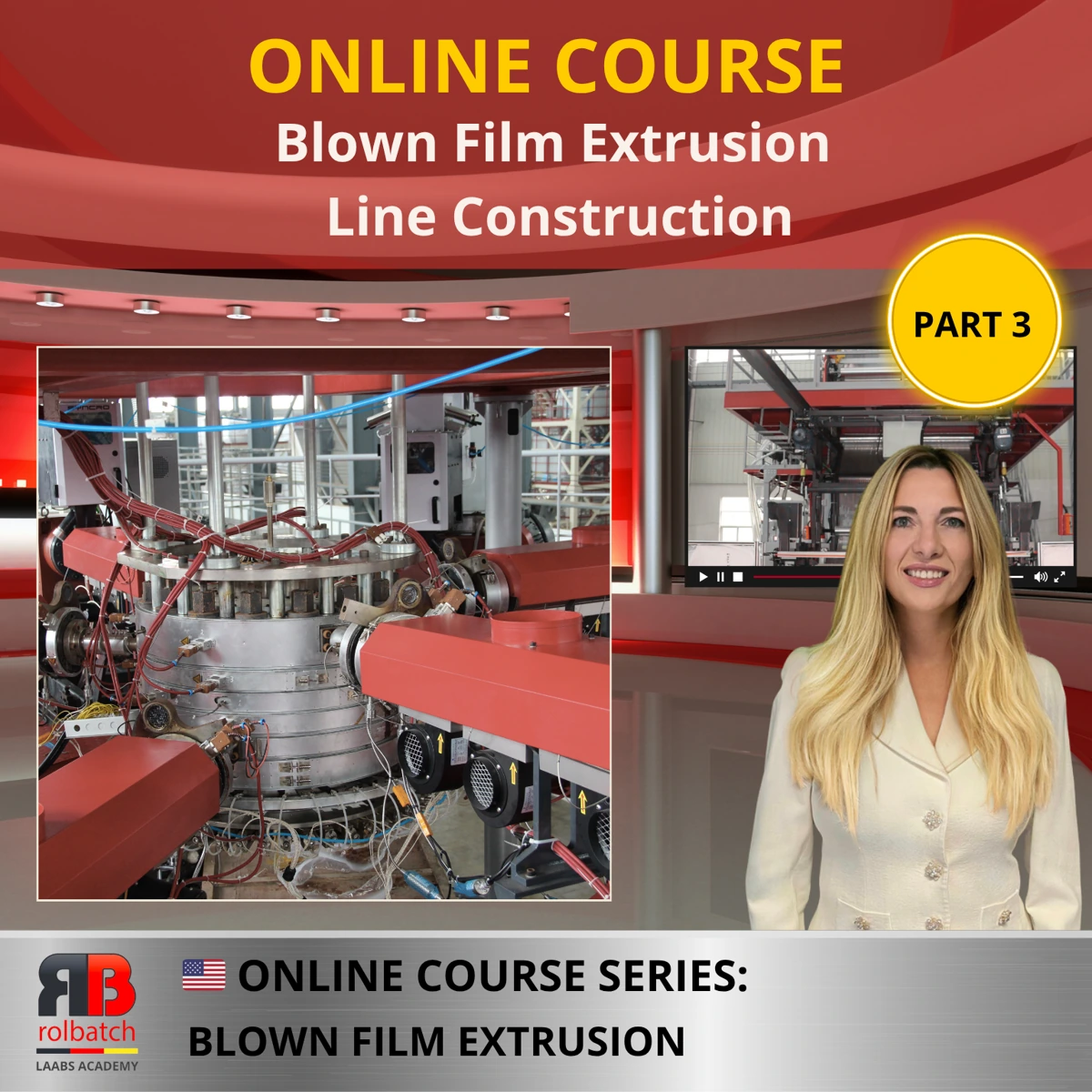
Film extrusion line construction
The course explains the construction and functions of the components of a blown film production line. It covers raw material conveying and plasticisation, filtration, the die, cooling, film bubble stabilisation, haul-off and winding.
The material helps connect an observed problem with the operation of a specific machine component. It is useful for operators, process engineers and maintenance teams when analysing changes in pressure, output, thickness and roll quality.
Skills developed in the course
- How the extruder works: barrel zones, screw design and compression ratio, and how these affect melt quality and output stability
- How extrusion die distributes the melt and what determines thickness uniformity around the film bubble
- How air ring and cooling system control the frost line, film bubble stability and film optical properties
- How screen changers and melt filtration protect quality and what happens when they are neglected
- How film bubble stabilisation and collapsing systems affect flatness, orientation and downstream processing
- How automation and control systems affect process repeatability and where their limitations lie
- How winding station determines the quality of the finished roll, and why problems at the winder often originate earlier in the process
Who is this course for?
- Machine operatorswho want to understand how every part of the line affects the film, beyond simply knowing where the buttons are
- Maintenance technicianswho need to connect mechanical problems with process behaviour
- Production engineers and process engineers responsible for line setup, optimisation and troubleshooting
- Production managers planning line upgrades, new installations or start-ups
- Companies commissioning new lines or training teams on unfamiliar equipment
Detailed topic coverage
The extruder: construction and operating principle How the screw, barrel and drive work together. How screw geometry affects melt quality, output and energy consumption.
The extrusion die: melt distribution and film formation How the die distributes the melt into a uniform film tube. What causes thickness variations and how die design affects them.
The cooling system: air ring and film bubble stability How the air ring controls the frost line and film bubble shape. The relationship between cooling capacity, production speed and film properties.
Screen changers and melt filtration Why filtration matters, how different types of screen changers work, and what happens to process stability when filters are not managed properly.
Film bubble stabilisation and tubular film guiding How the film bubble is guided, collapsed and spread, and how these systems affect film flatness, wrinkle formation and orientation.
Automation and process control How control systems ensure repeatability: gravimetric dosing, thickness measurement, IBC and their integration with the entire process.
Winding: the final stage that reveals everything How the winding station affects roll quality, tension control and suitability for downstream processing. Why many “winding problems” originate earlier in the process.
Course format
- Practical PDF materials covering line construction, component functions and their impact on process behaviour
- Video and audio explanations for selected topics: extruder operation, extrusion die function and cooling dynamics
- Final quiz assessing knowledge of line construction and component interaction
A Rolbatch Academy certificate of participation and the opportunity to earn a diploma after a knowledge assessment. The requirements are explained in the FAQ.
Part 1 gives the team process logic. Part 2: material logic. Part 3: machine logic. Together, these three courses provide a complete foundation for process optimisation (Part 4) and everything that follows.
Learning arrangements and ordering
The course includes PDF materials and video and audio explanations of selected topics. Participants work at their own pace and can revisit the materials during the access period. Completion, certificate and diploma requirements are explained in the FAQ.
Please include the number of participants, language and preferred date in your enquiry. We will confirm availability, the access period and terms for your team. We accept orders by email. You can combine selected parts, Executive and books in one enquiry.
What does this part cover?
- The extruder, screw, die and melt filtration system.
- The cooling ring and film bubble stabilisation systems.
- Haul-off, tubular film collapsing and the winder.
- Relationships between the operation of line components and product quality.
When should you choose this course?
Choose this part when introducing an employee to work on the line, or when operators, process engineers and maintenance teams need shared knowledge of its component functions.
How do you use the materials?
You learn online and revisit selected topics during the access period. You can choose the course on its own or combine it with other parts of the programme. In the offer, we will confirm the language, activation date, access period and terms for the selected number of participants.
Course knowledge should be applied with reference to the documentation, equipment and working rules of the specific plant.
Course language
Operator courses, Parts 1-9, are available in Polish, English, German and Spanish. The Executive programme is currently available in English only. We prepare other languages, including Italian and Russian, on request. For orders of at least 10 licences for the same course for 10 people, translation into an additional language is included at no extra charge. An additional translation charge applies to smaller groups. We will confirm the preparation timeframe in the offer.
Specify the language in your enquiry