
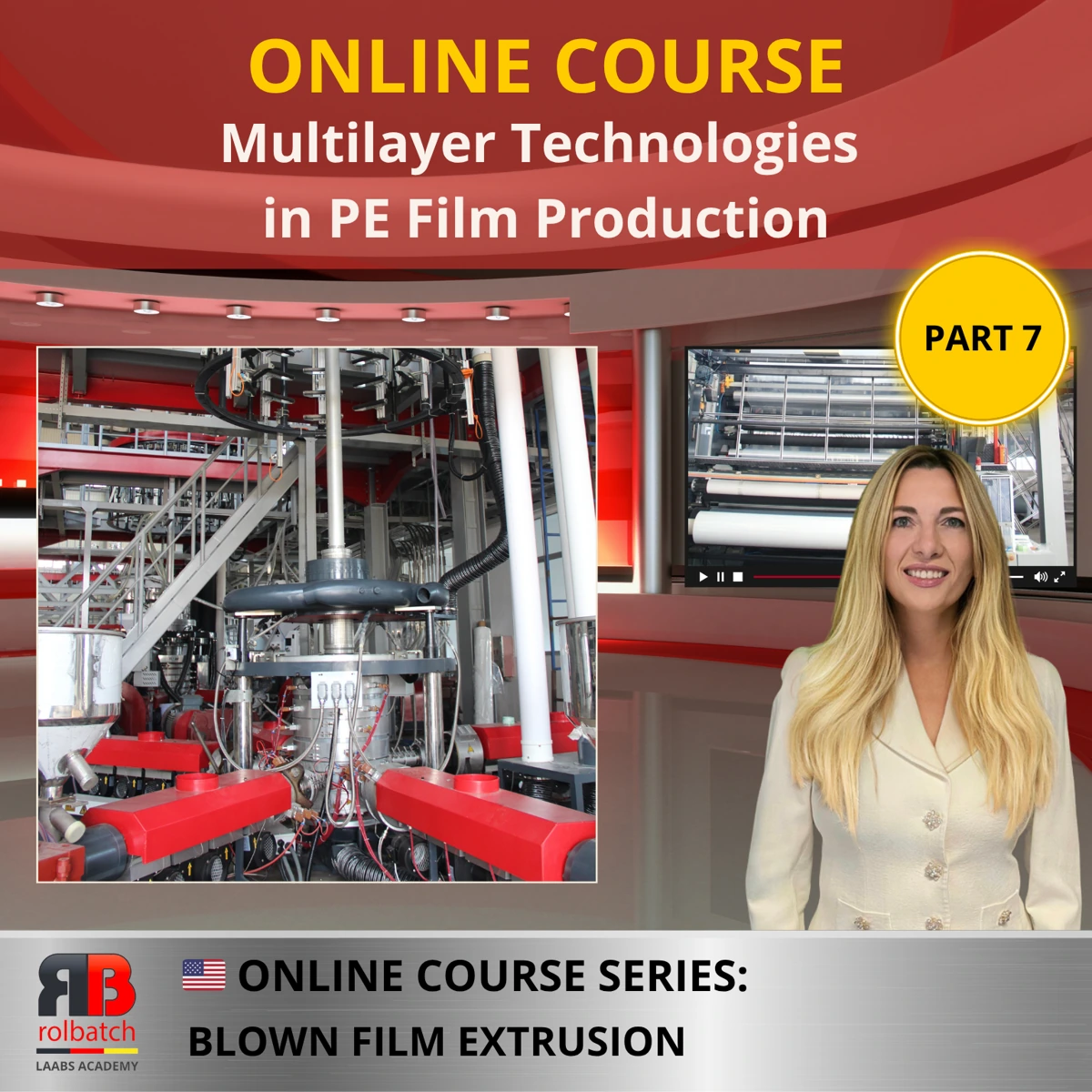
Multilayer technologies in PE film production
Coextrusion principles, the functions of individual layers and material selection. How the structure and layer ratios affect film properties, process stability and production costs.
You can add other courses, Executive and books to one enquiry.
Detailed programme description
Expand the full course descriptionCollapse the full description
Multilayer technologies in film production
The course presents multilayer blown film coextrusion. It discusses layer functions, material selection, their proportion in the structure and their impact on the properties of the finished film.
Topics cover both structural design and process operation. Participants learn the relationships between layer formulations, extrusion stability, product quality and raw material costs.
Skills developed in the course
- Understand the function of each layer: outer (surface properties, printability and resistance), core (stiffness and stability), inner (sealability, slip and adhesion), and how they work together as a system
- Analyse typical 3-layer and 5-layer film configurations: symmetrical and asymmetrical, and understand why each structure was designed in a particular way
- Understand coextrusion: how the melt is distributed in a multilayer extrusion die and how the layers are formed into a single tubular film structure
- Control layer ratios and understand how the percentage of each layer affects film properties, process stability and material cost
- Recognise how film bubble formation and cooling differ between multilayer and monolayer blown film extrusion, and what this means for the frost line, thickness uniformity and film quality
- Make rational material allocation decisions: placing the right resin in the right layer to optimise both properties and costs
Who is this course for?
- Machine operators operating 3-layer or 5-layer blown film extrusion lines who want to understand how the layer structure affects what they observe on the line: film bubble behaviour, thickness and film properties
- Production engineers and process engineers responsible for layer structure design, material selection and process settings on multilayer blown film extrusion lines
- Quality specialistswho need to connect film performance problems with specific layers in the structure
- Production managers and plant directors planning new multilayer extrusion lines, expanding multilayer production or analysing changes in layer design to optimise costs
- Companies currently producing monolayer PE filmthat want to understand multilayer blown film technology before investing in new equipment
Detailed topic coverage
Blown film types: monolayer, 3-layer and 5-layer When each type is appropriate, what determines the addition of further layers, and the logic of selecting a film structure according to product requirements.
Layer functions: outer, core and inner What each layer is responsible for and how it affects film properties: mechanical strength, surface quality, sealability and processability.
Typical 3-layer and 5-layer configurations Symmetrical and asymmetrical structures used in blown film production: how they are designed, why certain combinations work, and the trade-offs involved.
Coextrusion: how multilayer blown film is made How melt from several extruders is combined in the extrusion die and distributed into a layered tubular film structure, and where problems can arise during coextrusion.
Film bubble formation in multilayer blown film extrusion How the presence of multiple layers affects film bubble stability, frost line behaviour and cooling, and why multilayer film bubbles behave differently from monolayer ones.
Designing layer ratios for optimum properties How the percentage of each layer affects film properties, process stability and raw material costs, and how to find the right balance between quality and cost.
Rational use of raw materials in multilayer structures How to allocate PE resins across layers to maximise performance while minimising costs: using expensive resins only where they actually add value to the final product.
Course format
- Practical PDF materials covering multilayer blown film logic, layer functions, coextrusion principles and layer structure design
- Video and audio explanations for selected topics: coextrusion flow, layer formation and structural analysis
- Final quiz assessing knowledge of multilayer construction and its impact on film properties and process behaviour
A Rolbatch Academy certificate of participation and the opportunity to earn a diploma after a knowledge assessment. The requirements are explained in the FAQ.
Learning arrangements and ordering
The course includes PDF materials and video and audio explanations of selected topics. Participants work at their own pace and can revisit the materials during the access period. Completion, certificate and diploma requirements are explained in the FAQ.
Please include the number of participants, language and preferred date in your enquiry. We will confirm availability, the access period and terms for your team. We accept orders by email. You can combine selected parts, Executive and books in one enquiry.
What does this part cover?
- Principles of multilayer film coextrusion.
- Layer functions and material selection for each layer.
- Layer ratios and the properties of the finished film.
- Film structure, production stability and costs.
When should you choose this course?
Choose this part for operators and process engineers on multilayer lines, and teams developing their knowledge of layer structures and functions.
How do you use the materials?
You learn online and revisit selected topics during the access period. You can choose the course on its own or combine it with other parts of the programme. In the offer, we will confirm the language, activation date, access period and terms for the selected number of participants.
Course knowledge should be applied with reference to the documentation, equipment and working rules of the specific plant.
Course language
Operator courses, Parts 1-9, are available in Polish, English, German and Spanish. The Executive programme is currently available in English only. We prepare other languages, including Italian and Russian, on request. For orders of at least 10 licences for the same course for 10 people, translation into an additional language is included at no extra charge. An additional translation charge applies to smaller groups. We will confirm the preparation timeframe in the offer.
Specify the language in your enquiry