Operators and process engineers
Process fundamentals, materials, line construction, quality control and troubleshooting. Support for onboarding new staff and developing experienced employees.
From practitioners, for practitioners
Courses, books and consulting for the plastics processing and recycling industry. For sales teams, operators, process engineers and management.
Operator courses, Parts 1-9. The Executive programme for management. Printed books and e-books.
Select the courses and publications that interest you. Request an offer for yourself or your team.
We accept orders by email: Course enquiries.

The programme can be tailored to the employee's experience, role and the type of film produced.
Process fundamentals, materials, line construction, quality control and troubleshooting. Support for onboarding new staff and developing experienced employees.
Topics can be selected to match employees' duties and the plant's needs. A structured learning path covering production, quality and costs.
The Executive programme connects film production knowledge with an analysis of profitability, losses, indicators and investment decisions.
Each course can be selected separately. Part 1 is the starting point for new operators. The following parts develop knowledge according to the tasks performed at the plant.
From practitioners, for practitioners. Lower losses, better film, more predictable production.
We accept orders by email. Individual course prices are available in the Rolbatch Academy catalogue. For several courses or a larger number of participants, we will prepare a combined offer.
Check prices and detailsOperator courses, Parts 1-9, are available in Polish, English, German and Spanish. The Executive programme is currently available in English only. We prepare other languages, including Italian and Russian, on request. For orders of at least 10 licences for the same course for 10 people, translation into an additional language is included at no extra charge. An additional translation charge applies to smaller groups. We will confirm the preparation timeframe in the offer.
You can select one part, several parts or the entire programme.
The production process from raw material preparation and plasticisation to film bubble formation, cooling, haul-off and winding. The fundamentals needed to understand how the whole line works.
A starting point: onboarding new operators and establishing the fundamentals.
The course presents the complete PE film production process: raw material preparation, plasticisation, flow through the die, film bubble formation and cooling, haul-off and winding. It explains how the operation of successive line components affects the quality of the finished roll.
The material is primarily intended for operator onboarding and establishing shared basic knowledge within the team. It also supports cooperation between production, quality control and maintenance.
How does blown film extrusion work? The full production cycle: from raw material plasticisation to film bubble formation and final winding.
What are the key components of the production line? The extruder, extrusion die, air ring, screen changers, winding station and control system: how each works and its impact on your film.
Which process parameters have the greatest impact on film quality? Temperature, pressure, screw speed and film bubble stability: how they affect the final product and how to control them.
What are the main challenges in film production? Common production problems, how to recognise them early and how to prevent them.
How do process settings affect downstream processing? The impact of parameter adjustments on film properties, printability, sealability and converting efficiency.
A Rolbatch Academy certificate of participation and the opportunity to earn a diploma after a knowledge assessment. The requirements are explained in the FAQ.
The course includes PDF materials and video and audio explanations of selected topics. Participants work at their own pace and can revisit the materials during the access period. Completion, certificate and diploma requirements are explained in the FAQ.
Please include the number of participants, language and preferred date in your enquiry. We will confirm availability, the access period and terms for your team. We accept orders by email. You can combine selected parts, Executive and books in one enquiry.
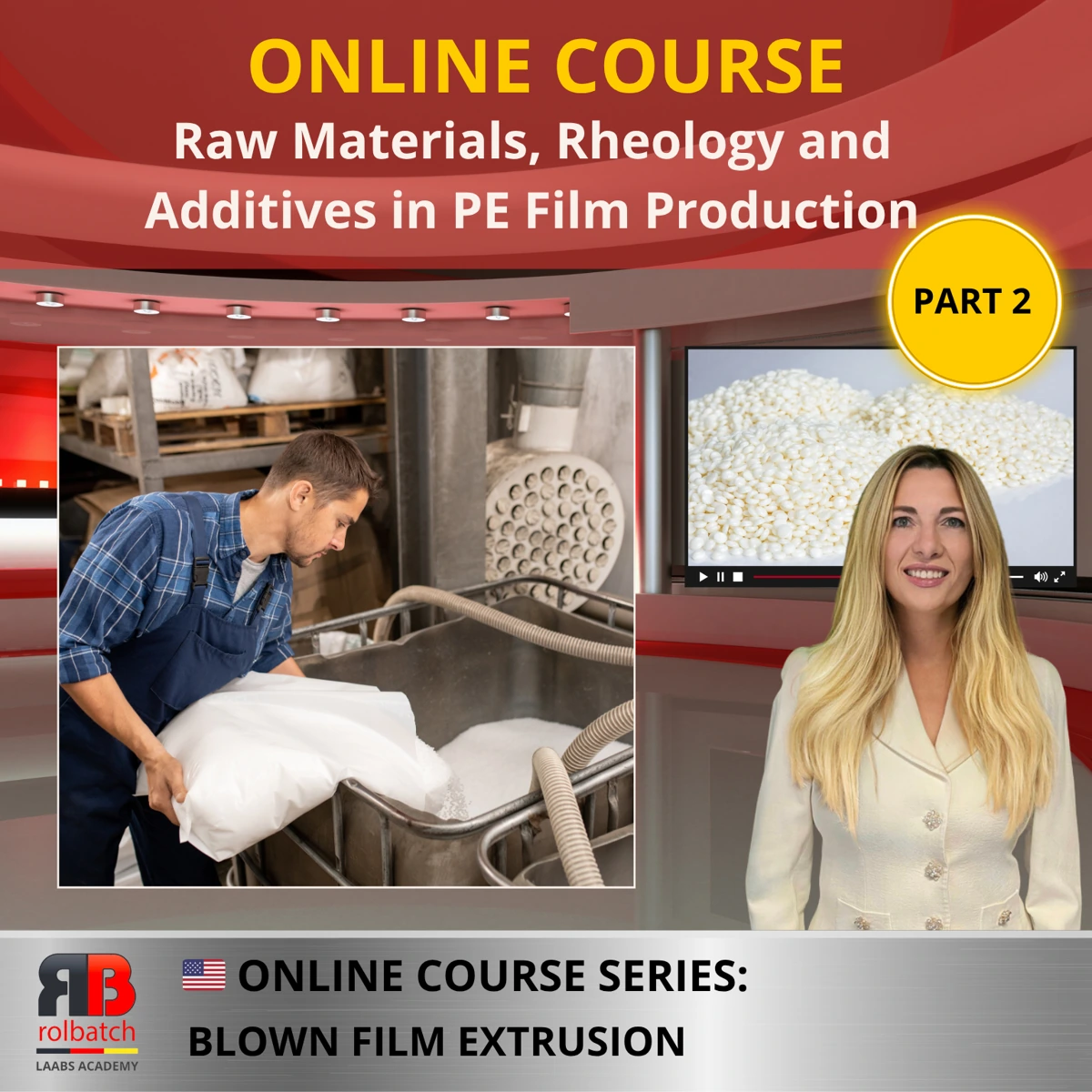
The properties of LDPE, LLDPE, mLLDPE, MDPE and HDPE, and the importance of rheology, additives and regranulate. Relationships between material selection, film bubble stability and product quality.
For teams working with formulations and raw material variability.
The course covers the selection of polymers and additives for blown film production. It connects raw material properties with melt behaviour during extrusion, film bubble stability and product properties.
Particular attention is given to differences between polyethylene grades, batch variability and the interpretation of test results. Participants learn the relationships needed when changing a formulation, supplier or proportion of recycled raw materials.
Polymer melt rheology in film extrusion What rheology means in practice: how melt viscosity, elasticity and melt strength determine film bubble stability, thickness uniformity and cooling behaviour. Why MFI alone is not enough.
Rheological characteristics of polyethylenes used in film extrusion A comparison of LDPE, LLDPE, metallocene LLDPE, MDPE and HDPE: how each behaves differently under shear and extension, and what this means for the process.
How raw material rheology affects film bubble stability and film quality The relationship between melt properties and what you observe on the line: frost line position, thickness variation, mechanical strength and optical properties.
Additives and their impact on melt behaviour How slip agents, antiblocking agents, UV stabilisers and other functional additives affect melt flow in the barrel and die, and the risks of incorrect dosing.
Regrind and regranulate: impact on rheology and process stability Why regrind changes melt properties, why the same blend can behave differently between batches, and how to minimise instability when working with secondary materials.
From rheology to production decisions How to interpret process behaviour when changing raw materials, additives or regrind content, and make decisions based on melt properties rather than guesswork.
Quality control and laboratory results in context Which laboratory tests actually matter for blown film production, and how to connect measurement results with observations on the line.
A Rolbatch Academy certificate of participation and the opportunity to earn a diploma after a knowledge assessment. The requirements are explained in the FAQ.
Part 1 gives the team an understanding of process logic. Part 2 provides material logic. Together, they form the foundation for everything that follows: line construction, process optimisation, multilayer technologies and troubleshooting.
The course includes PDF materials and video and audio explanations of selected topics. Participants work at their own pace and can revisit the materials during the access period. Completion, certificate and diploma requirements are explained in the FAQ.
Please include the number of participants, language and preferred date in your enquiry. We will confirm availability, the access period and terms for your team. We accept orders by email. You can combine selected parts, Executive and books in one enquiry.
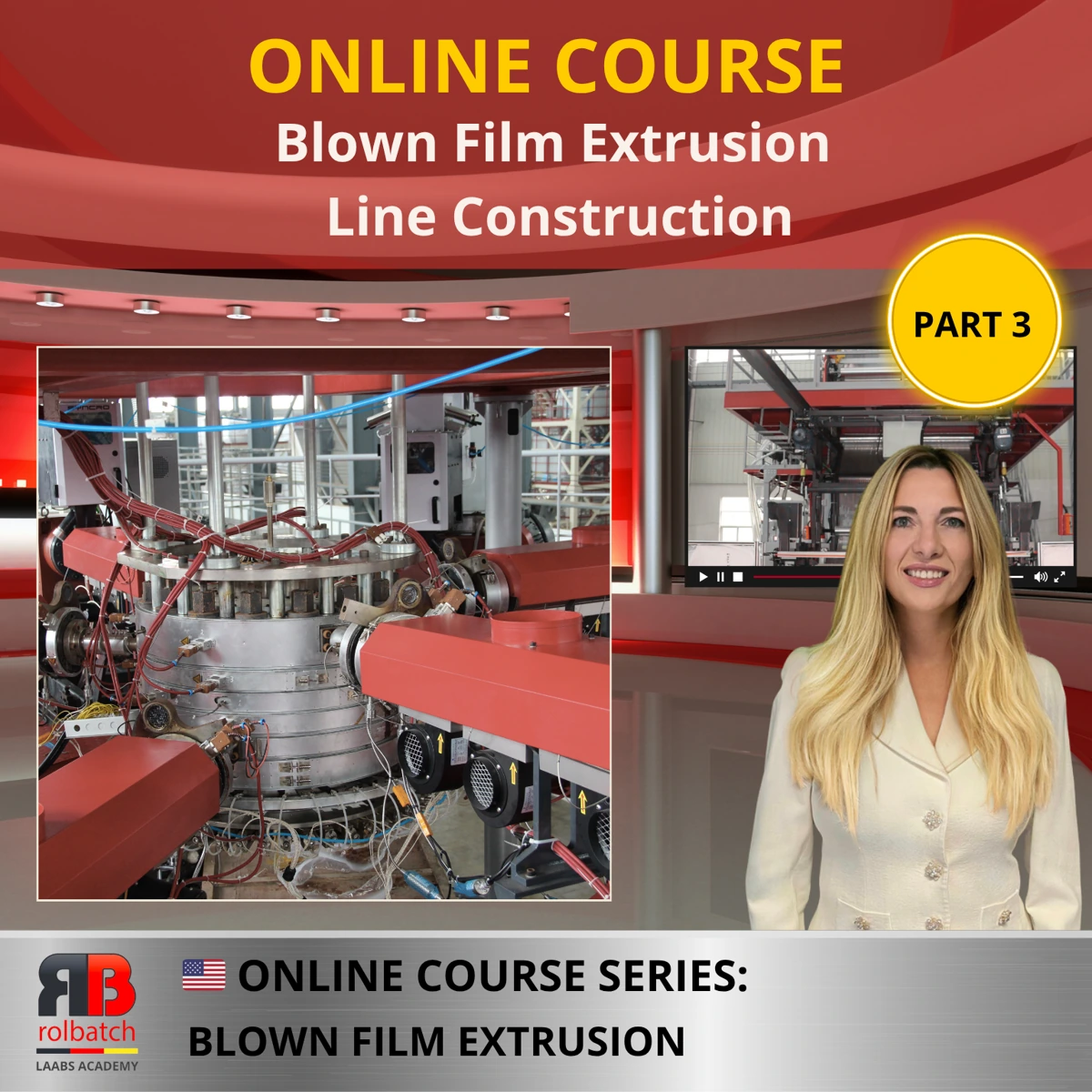
The functions of the extruder, screw, die, filtration system, cooling, film bubble stabilisation, haul-off and winder. How individual components affect the process.
For operators, process engineers and maintenance teams.
The course explains the construction and functions of the components of a blown film production line. It covers raw material conveying and plasticisation, filtration, the die, cooling, film bubble stabilisation, haul-off and winding.
The material helps connect an observed problem with the operation of a specific machine component. It is useful for operators, process engineers and maintenance teams when analysing changes in pressure, output, thickness and roll quality.
The extruder: construction and operating principle How the screw, barrel and drive work together. How screw geometry affects melt quality, output and energy consumption.
The extrusion die: melt distribution and film formation How the die distributes the melt into a uniform film tube. What causes thickness variations and how die design affects them.
The cooling system: air ring and film bubble stability How the air ring controls the frost line and film bubble shape. The relationship between cooling capacity, production speed and film properties.
Screen changers and melt filtration Why filtration matters, how different types of screen changers work, and what happens to process stability when filters are not managed properly.
Film bubble stabilisation and tubular film guiding How the film bubble is guided, collapsed and spread, and how these systems affect film flatness, wrinkle formation and orientation.
Automation and process control How control systems ensure repeatability: gravimetric dosing, thickness measurement, IBC and their integration with the entire process.
Winding: the final stage that reveals everything How the winding station affects roll quality, tension control and suitability for downstream processing. Why many “winding problems” originate earlier in the process.
A Rolbatch Academy certificate of participation and the opportunity to earn a diploma after a knowledge assessment. The requirements are explained in the FAQ.
Part 1 gives the team process logic. Part 2: material logic. Part 3: machine logic. Together, these three courses provide a complete foundation for process optimisation (Part 4) and everything that follows.
The course includes PDF materials and video and audio explanations of selected topics. Participants work at their own pace and can revisit the materials during the access period. Completion, certificate and diploma requirements are explained in the FAQ.
Please include the number of participants, language and preferred date in your enquiry. We will confirm availability, the access period and terms for your team. We accept orders by email. You can combine selected parts, Executive and books in one enquiry.
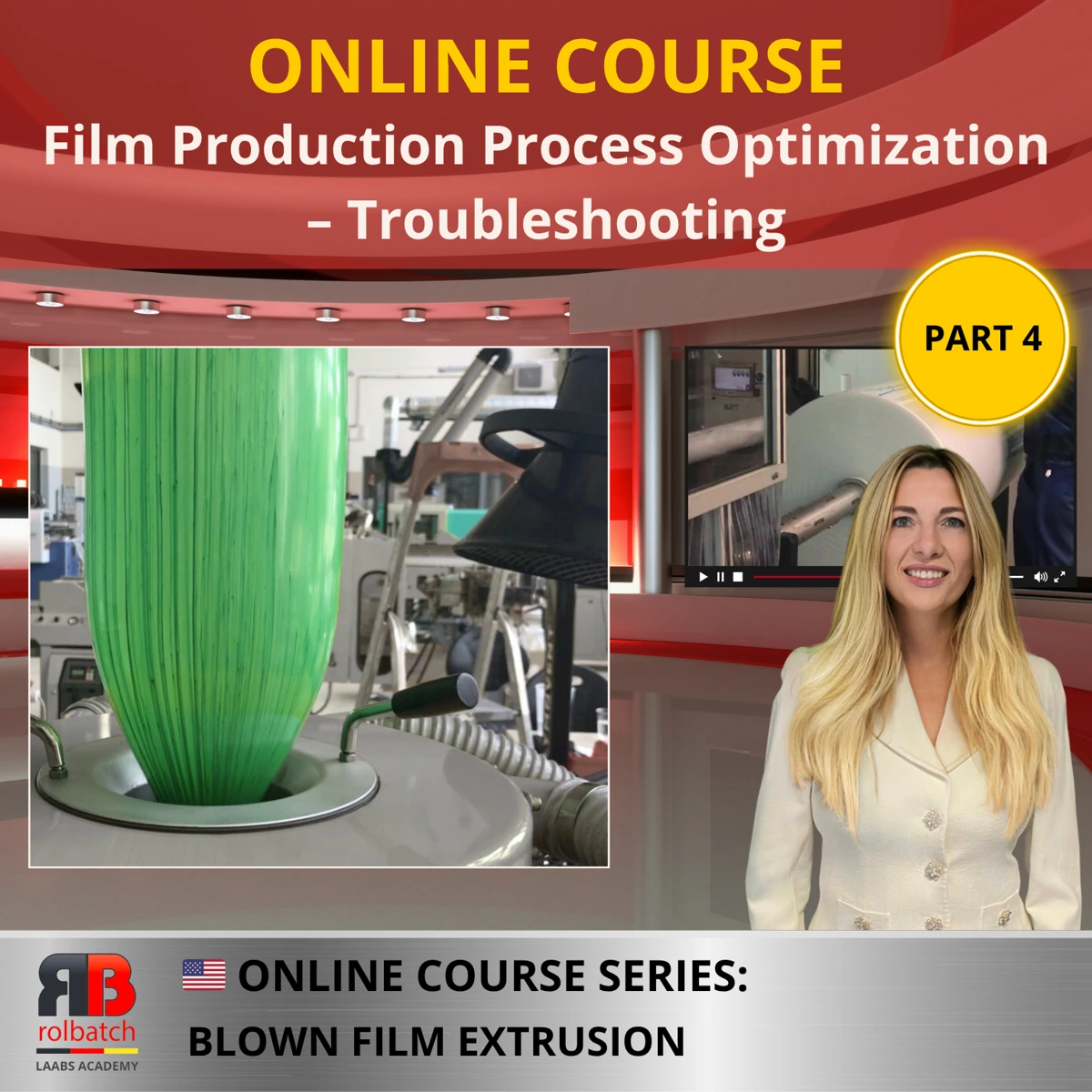
Identifying the causes of film bubble instability, uneven thickness, surface defects, wrinkles and winding problems. A structured approach to solving production problems.
For teams seeking to better diagnose recurring defects.
The course addresses identifying the causes of film defects and unstable line operation. It covers the sequence for checking raw materials, settings and equipment when problems occur with the film bubble, thickness, surface and winding.
Participants learn to analyse a symptom, check possible causes and evaluate the result of a correction. Actions at the machine should take account of the manufacturer's documentation and the plant's safety rules.
The most common film defects and how to eliminate them A structured overview of the problems most frequently encountered on blown film extrusion lines and the diagnostic logic behind each one.
Uneven film thickness What causes thickness variation around the film bubble and in the machine direction, and how to correct it through die and cooling settings and process parameters.
Surface defects: orange peel, streaks and discolouration How to identify whether the cause is temperature, material, contamination or a mechanical factor, and how to proceed in each case.
Film bubble instability: drift, oscillations and collapse How cooling, pressure and melt properties interact to destabilise the film bubble, and how to regain control.
Mechanical damage to film Scratches, deformations and stress marks: where they arise in the process and how to prevent them.
Optimising cooling: avoiding deformation and internal stresses How cooling rate and uniformity affect film structure, flatness and properties in downstream processing.
Screw speed and pressure: their impact on quality How these key parameters affect melt homogeneity, output stability and the final properties of the film.
Rapid correction of process errors during production How to make effective corrections while following safety rules, assessing whether the line needs to be stopped and avoiding new problems.
Winding defects: wrinkling, delamination and conical rolls Why most winding problems do not start at the winder, and how to find their actual source earlier in the process.
Film sticking: why thin film sticks and how to prevent it The role of temperature, additives and process conditions in film blocking and sticking.
A Rolbatch Academy certificate of participation and the opportunity to earn a diploma after a knowledge assessment. The requirements are explained in the FAQ.
This course is the turning point of the series.
Parts 1-3 give your team understanding. Part 4 provides the ability to act in practice. Every subsequent course, covering supporting technologies, multilayer technologies, recycling and cost analysis, builds on the troubleshooting skills developed here.
The course includes PDF materials and video and audio explanations of selected topics. Participants work at their own pace and can revisit the materials during the access period. Completion, certificate and diploma requirements are explained in the FAQ.
Please include the number of participants, language and preferred date in your enquiry. We will confirm availability, the access period and terms for your team. We accept orders by email. You can combine selected parts, Executive and books in one enquiry.
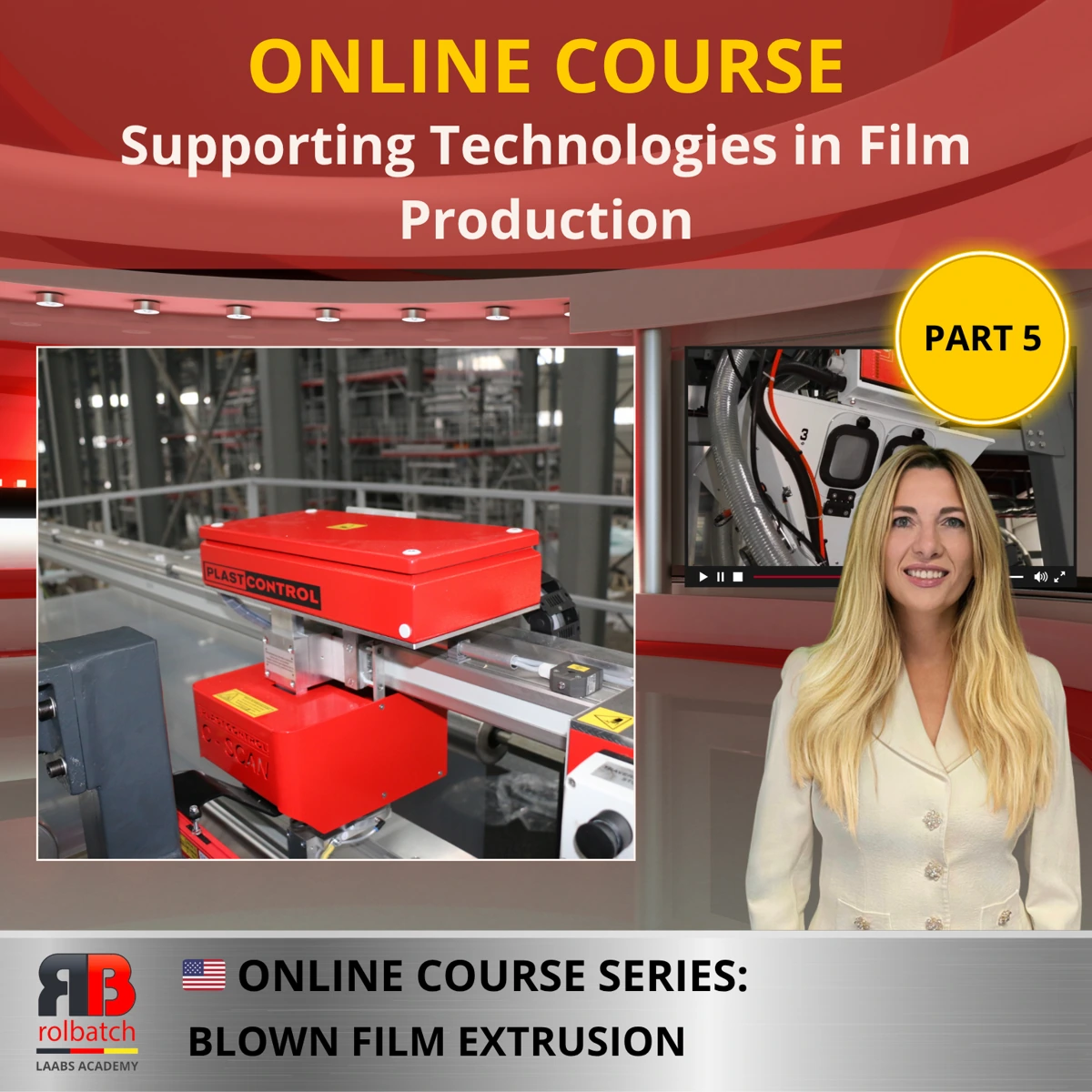
Gravimetric dosing, thickness measurement, internal bubble cooling (IBC), melt filtration, corona treatment and automation. The role of auxiliary equipment in achieving consistent quality.
For those developing their knowledge of process control and stabilisation.
The course covers equipment and systems that support process operation: dosing, thickness measurement, profile control, IBC cooling and melt filtration. It explains their functions and limitations.
Participants learn the relationships between system readings and actual process conditions. The material helps assess whether equipment is operating correctly, needs calibration or servicing, or is compensating for another problem on the line.
Gravimetric and volumetric dosing systems How each type works, what affects dosing accuracy, and how dosing errors propagate through the process unnoticed.
Dosing errors and their impact on the process How to recognise when dosing instability causes problems that resemble temperature, pressure or material issues.
Blend homogeneity: when the blend is not what it seems Why the ratio in the hopper does not always match the ratio in the melt, and how this affects film properties and process repeatability.
Online thickness measurement systems What these systems actually measure, how sensor position and calibration affect results, and where the practical limits of measurement lie.
Automatic profile control When the system actually improves thickness distribution and when it compensates for a die or cooling problem that should be addressed at its source.
Air ring cooling and film bubble stability How air ring design and settings affect the frost line, film bubble shape and film quality, and how to optimise cooling without destabilising the process.
IBC: internal bubble cooling When IBC increases output and stability, and when it causes oscillations, pressure fluctuations or uneven cooling that creates problems downstream.
Screen changers and melt filtration How different types of screen changers work, how screen selection affects pressure and quality, and how to manage filter changes without interrupting the process.
Screen selection in practice How to select the right mesh for the material, film thickness and process conditions, and how filter management affects production continuity.
Cleaning the plasticising system (screw, barrel and die) When cleaning is necessary, how to recognise signs of contamination, and how to avoid degradation caused by improper cleaning.
Purging compounds: when they help and when they do not How to recognise when purging compounds solve the problem and when they merely mask the actual causes.
A Rolbatch Academy certificate of participation and the opportunity to earn a diploma after a knowledge assessment. The requirements are explained in the FAQ.
The course includes PDF materials and video and audio explanations of selected topics. Participants work at their own pace and can revisit the materials during the access period. Completion, certificate and diploma requirements are explained in the FAQ.
Please include the number of participants, language and preferred date in your enquiry. We will confirm availability, the access period and terms for your team. We accept orders by email. You can combine selected parts, Executive and books in one enquiry.
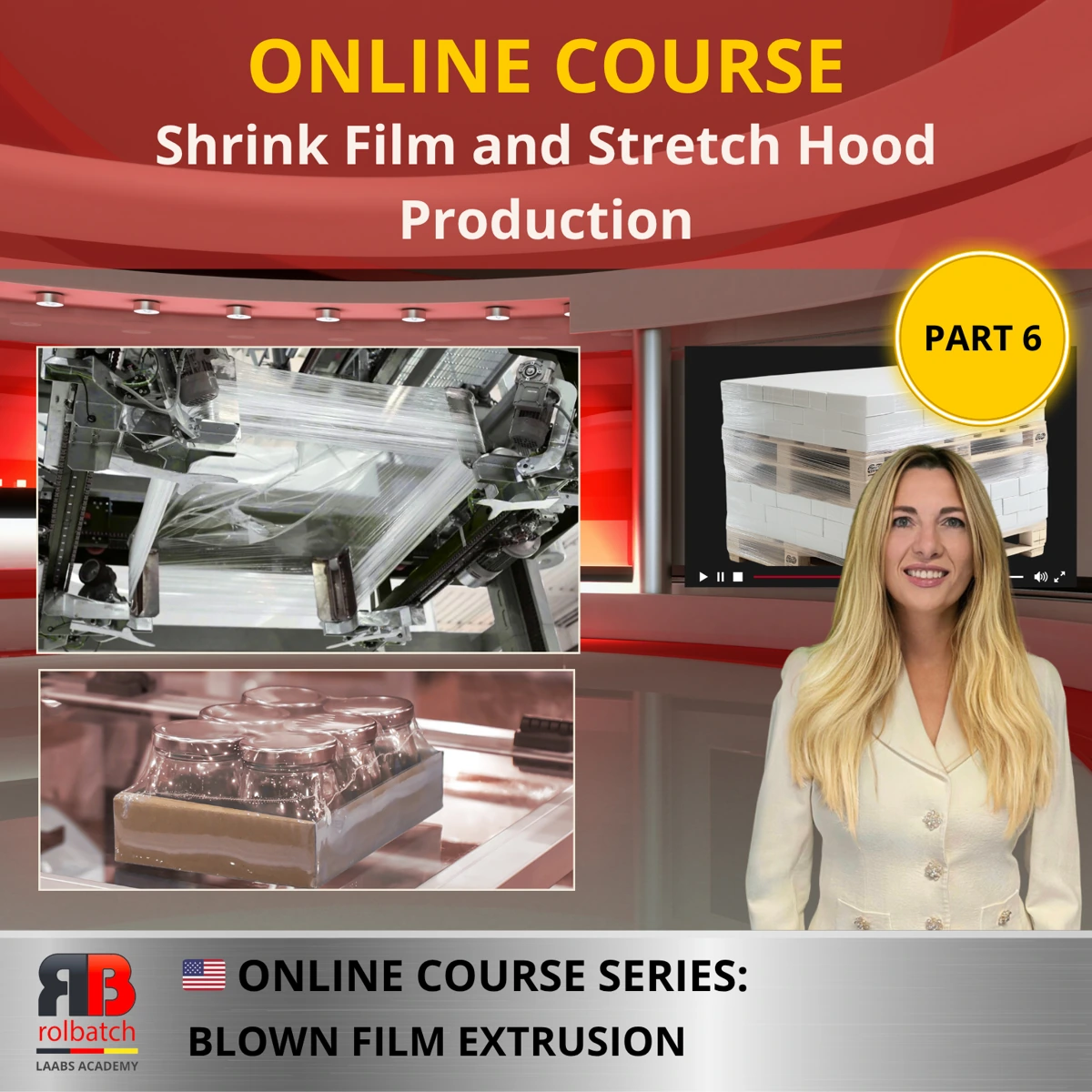
Selecting raw materials, formulations and parameters to meet shrink film and stretch hood requirements. The relationship between production conditions, shrinkage, elasticity and mechanical properties.
For plants producing films for load securing.
The course connects load securing requirements with the selection of raw materials, formulations and production conditions. It covers shrink films and stretch hood films, which differ in how they are applied and stabilise the pallet.
The relationships between stretching, shrinkage, strength and processing conditions are discussed. The material is intended for those responsible for producing and assessing the properties of these films.
Shrink film versus stretch hood: differences in technology and application How each type works, why the production approach is fundamentally different, and what this means for raw material selection, process settings and quality control.
Raw materials for shrink film: LDPE, LLDPE and EVA How each resin type affects shrink behaviour, optical properties and processability, and the trade-offs between transparency, shrink performance and process stability.
Raw materials for stretch hood What determines load holding force, puncture resistance and elastic recovery, and how material selection differs from shrink film.
The role of EVA and additives in shrink films How EVA content and functional additives change the film's response to heat, and when their use improves performance or creates new problems.
Film orientation (MD/TD): the key to shrinkage and strength How process settings control the direction and degree of shrinkage, and why orientation is the most important factor affecting film performance.
Process parameters for shrink film production Temperature profiles, BUR and cooling settings: how each parameter affects the degree of shrinkage, uniformity and final film quality.
Process parameters for stretch hood production How process setup differs from shrink film, and which parameters determine elongation, elastic recovery and load stability.
Film bubble stability with demanding formulations How higher EVA content and specialist blends affect film bubble behaviour, and how to maintain process stability with these materials.
Cooling and its impact on film structure How cooling rate and uniformity affect crystallinity, orientation and the mechanical properties that determine film performance.
Mechanical testing and process optimisation How to use tensile strength, elongation, shrink force and puncture resistance test results to identify problems linked to specific process conditions, and how to solve them.
A Rolbatch Academy certificate of participation and the opportunity to earn a diploma after a knowledge assessment. The requirements are explained in the FAQ.
The course includes PDF materials and video and audio explanations of selected topics. Participants work at their own pace and can revisit the materials during the access period. Completion, certificate and diploma requirements are explained in the FAQ.
Please include the number of participants, language and preferred date in your enquiry. We will confirm availability, the access period and terms for your team. We accept orders by email. You can combine selected parts, Executive and books in one enquiry.

Coextrusion principles, the functions of individual layers and material selection. How the structure and layer ratios affect film properties, process stability and production costs.
For operators and process engineers working on multilayer lines.
The course presents multilayer blown film coextrusion. It discusses layer functions, material selection, their proportion in the structure and their impact on the properties of the finished film.
Topics cover both structural design and process operation. Participants learn the relationships between layer formulations, extrusion stability, product quality and raw material costs.
Blown film types: monolayer, 3-layer and 5-layer When each type is appropriate, what determines the addition of further layers, and the logic of selecting a film structure according to product requirements.
Layer functions: outer, core and inner What each layer is responsible for and how it affects film properties: mechanical strength, surface quality, sealability and processability.
Typical 3-layer and 5-layer configurations Symmetrical and asymmetrical structures used in blown film production: how they are designed, why certain combinations work, and the trade-offs involved.
Coextrusion: how multilayer blown film is made How melt from several extruders is combined in the extrusion die and distributed into a layered tubular film structure, and where problems can arise during coextrusion.
Film bubble formation in multilayer blown film extrusion How the presence of multiple layers affects film bubble stability, frost line behaviour and cooling, and why multilayer film bubbles behave differently from monolayer ones.
Designing layer ratios for optimum properties How the percentage of each layer affects film properties, process stability and raw material costs, and how to find the right balance between quality and cost.
Rational use of raw materials in multilayer structures How to allocate PE resins across layers to maximise performance while minimising costs: using expensive resins only where they actually add value to the final product.
A Rolbatch Academy certificate of participation and the opportunity to earn a diploma after a knowledge assessment. The requirements are explained in the FAQ.
The course includes PDF materials and video and audio explanations of selected topics. Participants work at their own pace and can revisit the materials during the access period. Completion, certificate and diploma requirements are explained in the FAQ.
Please include the number of participants, language and preferred date in your enquiry. We will confirm availability, the access period and terms for your team. We accept orders by email. You can combine selected parts, Executive and books in one enquiry.
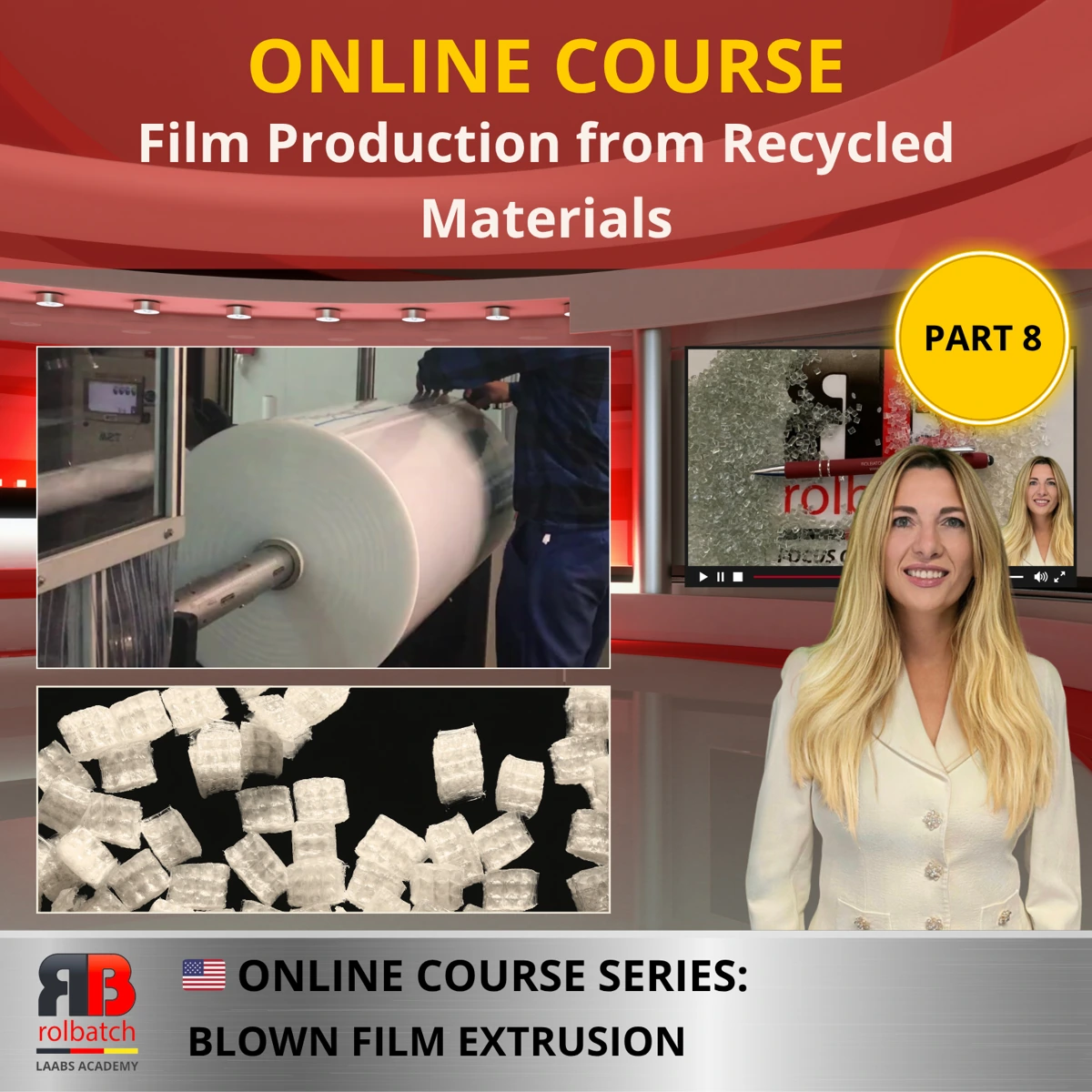
Assessing the suitability of regranulates and regrind, preparing blends and working with raw material variability. Reusing in-house production waste in film production.
For teams using regranulate and in-house waste.
The course discusses the use of regranulates and regrind in film production and the recovery of in-house production waste. It explains the importance of raw material origin, variability and preparation for processing.
The material covers problems related to contamination, changes in flow properties, colour and film consistency. Participants learn to assess the impact of recycled raw material on the formulation, settings and quality control.
How regranulate differs from virgin PE resin Fundamental differences in melt behaviour, contamination, thermal history and variability, and why treating regranulate like virgin material causes problems on a blown film extrusion line.
Sources of regranulate: PIR versus PCR How the origin of regranulate affects its quality, consistency and suitability for blown film extrusion, and why post-consumer regranulate requires a completely different approach from post-production regrind.
Assessing regrind quality: key parameters Melt flow index (MFI), moisture content, contamination levels and homogeneity: how to assess the raw material before introducing it to the blown film extrusion line.
Material variability and its impact on process stability How differences between regrind batches translate into process fluctuations, and how to recognise whether instability comes from the material, machine or settings.
Establishing the right blend ratio How to determine the optimum proportion of regrind to virgin raw material: balancing cost, quality and process stability without exceeding the capabilities of the blown film extrusion line.
Adjusting process parameters for regranulates Which temperature, screw speed and pressure settings need to change when processing regrind, and why standard settings for virgin raw material do not work.
The impact of regrind on film bubble stability and film formation Why blown film extrusion with regranulate presents specific challenges: melt inhomogeneity, frost line shifts and thickness variations, and how to address them.
Properties of film containing regranulate How regranulate affects mechanical strength, optical properties, surface quality and sealability, and what level of change is acceptable for different applications.
Design for recycling: closing the loop How to design blown film structures that can be effectively recycled at the end of their life: material and additive selection, and structural simplification.
Quality control in production with regrind Methods for monitoring the quality of raw material and finished film, and how to maintain production repeatability as the raw material changes.
A Rolbatch Academy certificate of participation and the opportunity to earn a diploma after a knowledge assessment. The requirements are explained in the FAQ.
Parts 1-7 give your team a complete foundation in blown film extrusion: process, materials, machines, optimisation, supporting technologies, specialist films and multilayer structures. Part 8 enables working with variable raw material: a skill that is becoming increasingly important as industry requirements for regranulate content grow.
The course includes PDF materials and video and audio explanations of selected topics. Participants work at their own pace and can revisit the materials during the access period. Completion, certificate and diploma requirements are explained in the FAQ.
Please include the number of participants, language and preferred date in your enquiry. We will confirm availability, the access period and terms for your team. We accept orders by email. You can combine selected parts, Executive and books in one enquiry.

The impact of raw material consumption, film thickness, waste, start-ups, changeovers and energy on production costs. Connecting daily decisions on the line with the plant's economic performance.
For managers and teams responsible for production efficiency.
The course shows how decisions on the line affect the cost per kilogram of film. It covers raw material consumption, actual thickness, waste, energy, working time, downtime and changeovers.
The material is intended for production teams and those responsible for plant efficiency. It supports loss analysis, performance comparisons and the economic assessment of proposed process changes.
The cost structure of blown film production A comprehensive breakdown: raw materials, energy, labour, depreciation and waste. Which cost components dominate, and where the greatest savings potential lies in blown film extrusion.
Raw material cost: the most important factor Why material cost is more than the purchase price. How film thickness tolerance, waste rate and blend ratios determine the actual raw material cost per kilogram of finished film.
The true cost of waste and production losses How to calculate waste costs correctly, including wasted energy, machine time, labour and lost production capacity. Why “2% waste” costs more than most people think.
Energy consumption analysis How to measure and assess energy cost per kilogram of blown film produced, and where energy losses most often occur in extrusion, cooling and auxiliary systems.
The cost of downtime and changeovers How to estimate the true cost of production stoppages, material changes and start-up losses, and which types of downtime have the greatest financial impact on your blown film extrusion line.
Process parameters and their impact on costs How temperature profiles, screw speed, cooling settings and target thickness directly affect production costs, and how to optimise for both quality and economics.
Line efficiency and OEE How to measure and interpret Overall Equipment Effectiveness (OEE) for a blown film extrusion line, and what the difference between actual and achievable OEE means financially.
Hidden cost drivers Losses that do not appear in standard reports: excessive thickness, oversizing, suboptimal regrind utilisation and energy waste. How to find them and estimate their impact on gross margin.
Cost-based optimisation decisions How to assess which process improvements deliver the highest financial return, so the team focuses its efforts where they create the greatest value for your blown film production.
A Rolbatch Academy certificate of participation and the opportunity to earn a diploma after a knowledge assessment. The requirements are explained in the FAQ.
The course includes PDF materials and video and audio explanations of selected topics. Participants work at their own pace and can revisit the materials during the access period. Completion, certificate and diploma requirements are explained in the FAQ.
Please include the number of participants, language and preferred date in your enquiry. We will confirm availability, the access period and terms for your team. We accept orders by email. You can combine selected parts, Executive and books in one enquiry.
Courses are delivered online at times that suit the participant. We confirm the available language version, activation date, access period and group terms in the offer. Select the parts that interest you to receive an offer tailored to your team.
The Executive programme is currently available in English only.
How can you increase EBITDA in blown film production? A programme for business owners, board members, financial and operating directors, and plant managers.
A programme for owners, boards, chief operating and financial officers, and managers of blown film production plants. It combines process knowledge with an analysis of costs, margins and EBITDA.
The scope covers production indicators, work organisation, material losses, changeovers and investment assessment. Participants learn how to prepare an action plan using data from their own plant.
The cost structure of blown film production and its impact on EBITDA A complete breakdown of production costs. Which components dominate. Where the greatest savings potential lies and which cost drivers managers most often underestimate.
Operating margin and process parameters How specific process settings affect margins. Which decisions improve financial performance and which increase costs.
Output and profitability: when producing more means losing more Why increasing line speed or output does not always improve results. Where the break-even point lies and how to recognise it.
Waste as a major source of financial losses How to calculate the true cost of production waste: material value, energy, machine time, labour and lost output. Sample calculations for a given waste percentage on a monthly and annual basis.
Process stability as the foundation of profit How instability translates into costs. The relationship between process repeatability, waste levels and gross margin.
Excessive film thickness and raw material consumption How to calculate additional material consumption when actual thickness exceeds the customer's requirement. Comparing measurements with the specification and assessing the cost of the deviation.
Team management and its impact on financial results How team discipline, knowledge levels and standardised process settings affect production stability and costs.
Selecting and interpreting production indicators Selecting indicators to match the plant's objectives. Interpreting results and using data to plan actions.
Technology investments: how to assess actual ROI How to assess whether a new machine, system or technology will actually pay for itself, and the most common investment mistakes in blown film production.
Case study: the impact of process changes on EBITDA Real examples of optimisation decisions and their measurable impact on financial performance.
Identifying production losses Areas that generate costs in daily production: measuring and costing them, and selecting measures to reduce losses.
Planning waste reduction Assessing organisational and process changes that can be introduced using existing equipment.
Start-up and changeover costs: time and material How to calculate changeover losses and what can realistically be reduced.
Raw material purchase price and total production cost When apparent savings on raw material prices lead to higher total production costs, and how to recognise this before it happens.
A 30-day action plan to improve EBITDA Specific steps your management team can take in the first month using existing resources, machinery and staff.
A Rolbatch Academy certificate of participation and the opportunity to earn a diploma after a knowledge assessment. The requirements are explained in the FAQ.
The course includes PDF materials and video and audio explanations of selected topics. Participants work at their own pace and can revisit the materials during the access period. Completion, certificate and diploma requirements are explained in the FAQ.
Please include the number of participants, language and preferred date in your enquiry. We will confirm availability, the access period and terms for your team. We accept orders by email. You can combine selected parts, Executive and books in one enquiry.
Explore available publications and upcoming editions. Select the books you would like to enquire about: you can combine them with courses in one message.
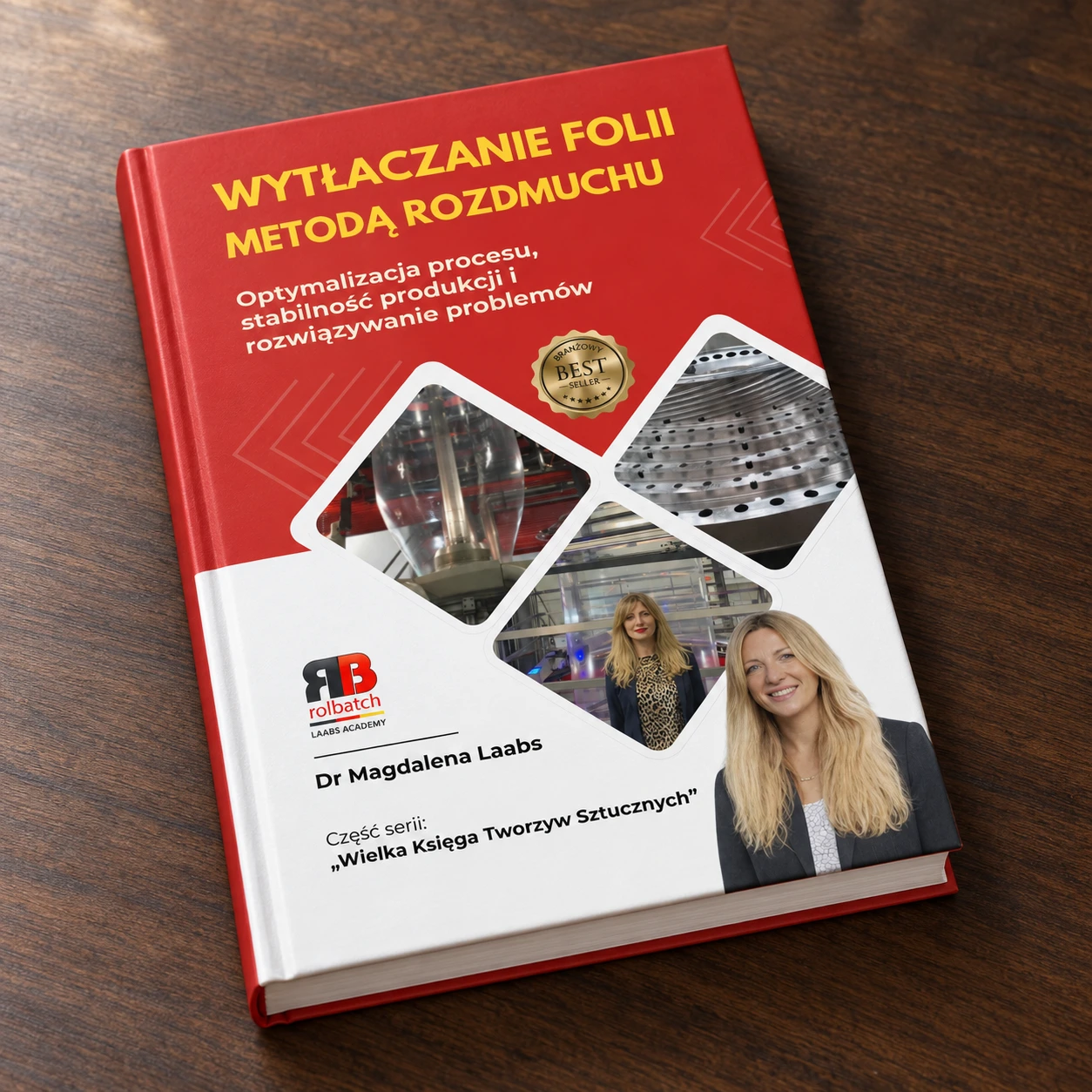
A practical book on operating the process, identifying the causes of defects and selecting corrective actions. It connects raw material issues with line operation, bubble stability, film quality and winding. For operators, process engineers, quality control and those responsible for production.
Production process optimisation and troubleshooting in blown film production.
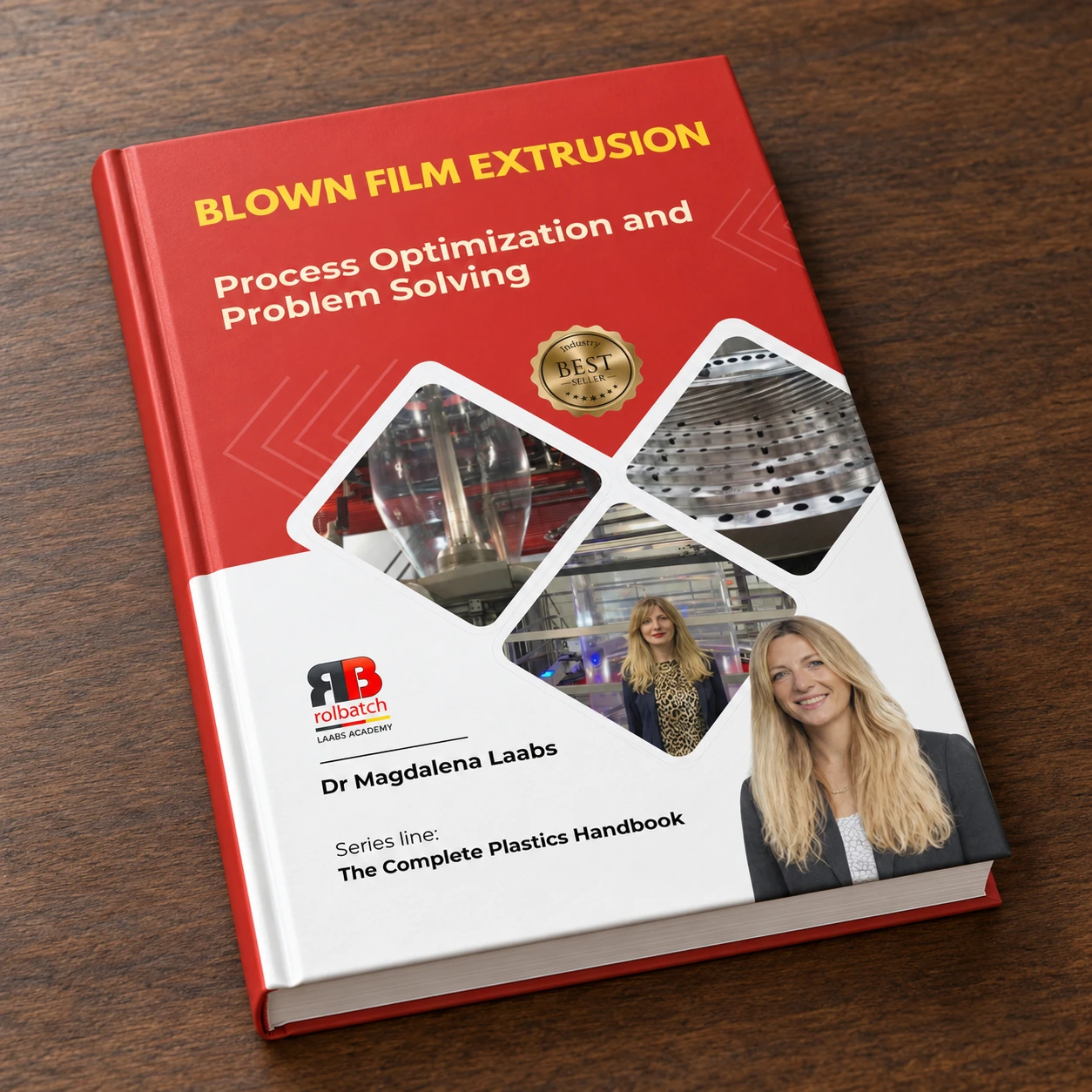
A practical book on operating the process, identifying the causes of defects and selecting corrective actions. It connects raw material issues with line operation, bubble stability, film quality and winding. For operators, process engineers, quality control and those responsible for production.
Production process optimisation and troubleshooting in blown film production.
Select the book language and the country whose regulations the edition covers. The Polish-language version is available both for plants in Poland and for Polish-speaking employees of plants in Germany.
The book has three editions: Polish with Polish regulations, Polish with German regulations, and German with German regulations. No translations into other languages are planned. The title in parentheses is a translation for reference only.
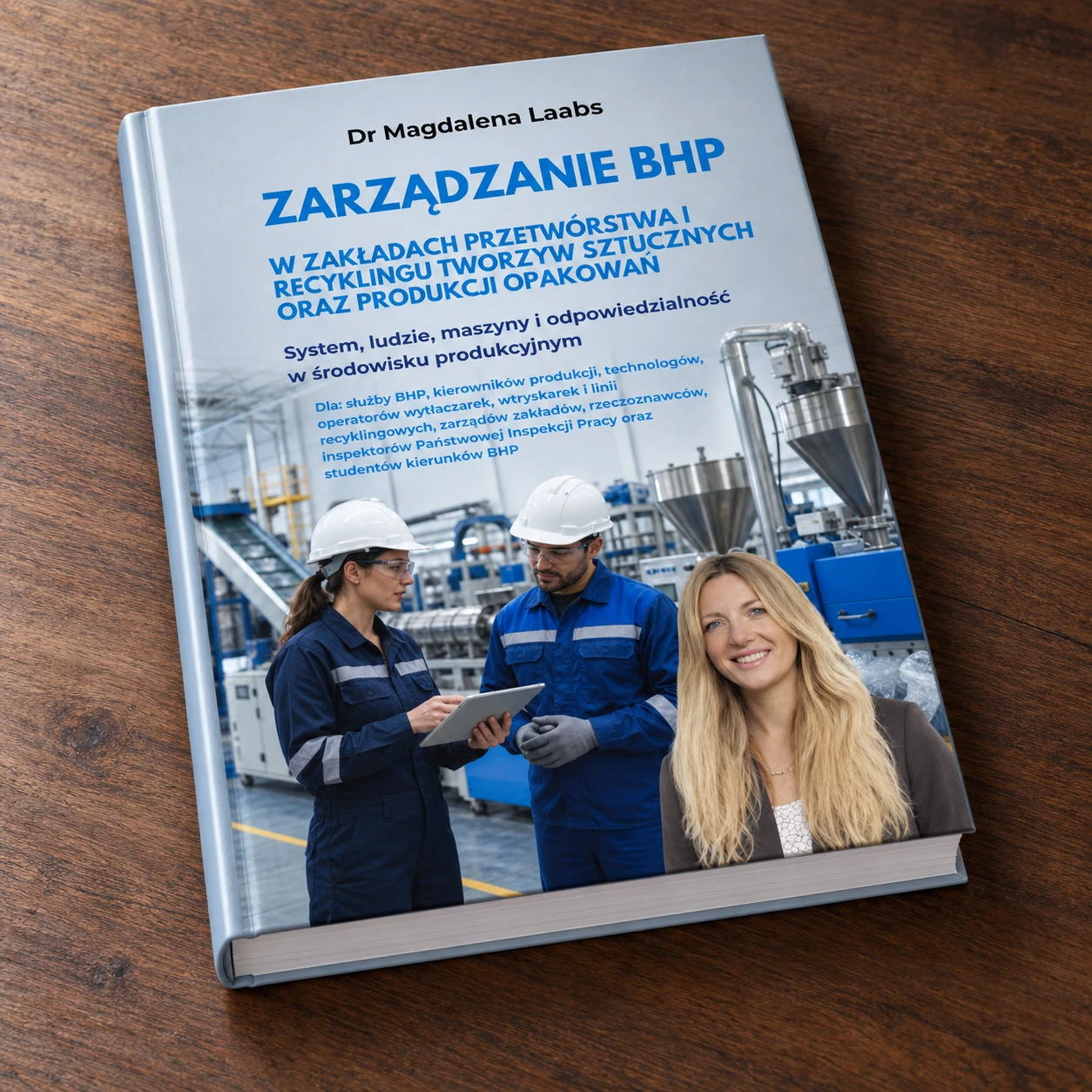
Polish language · Polish regulations
The book discusses occupational safety in the context of plastics processing and recycling plants. It shows the connections between materials, machines, work organisation and management responsibilities. It helps analyse risks and plan preventive measures.
Standard edition for plants operating in Poland.
The legal scope depends on the selected edition. The Polish version for Poland covers Polish regulations. Editions for plants in Germany concern German regulations, regardless of the book's language.
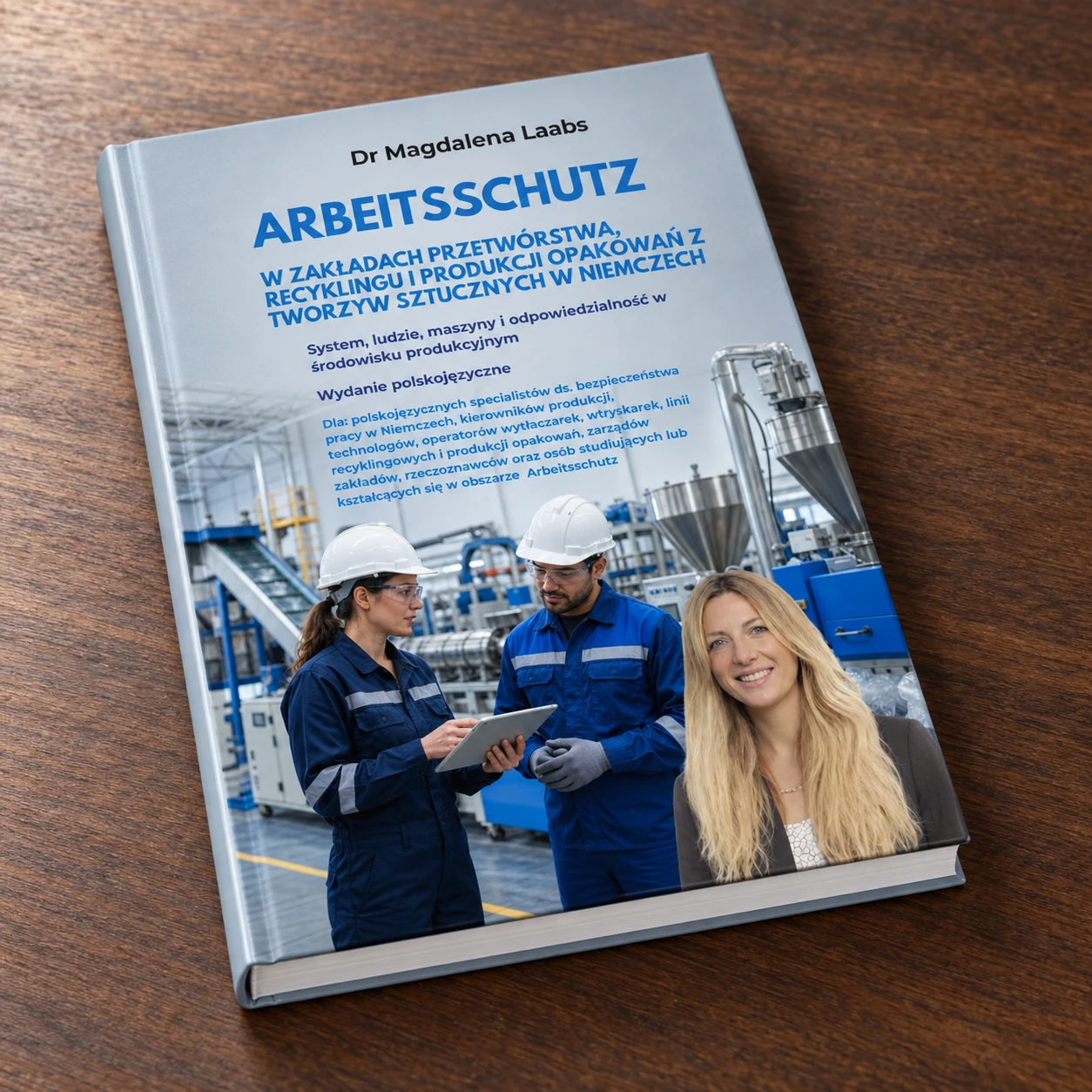
Polish language · German regulations
The book discusses occupational safety in the context of plastics processing and recycling plants. It shows the connections between materials, machines, work organisation and management responsibilities. It helps analyse risks and plan preventive measures.
An edition for Polish-speaking employees and management of plants operating in Germany.
The legal scope depends on the selected edition. The Polish version for Poland covers Polish regulations. Editions for plants in Germany concern German regulations, regardless of the book's language.
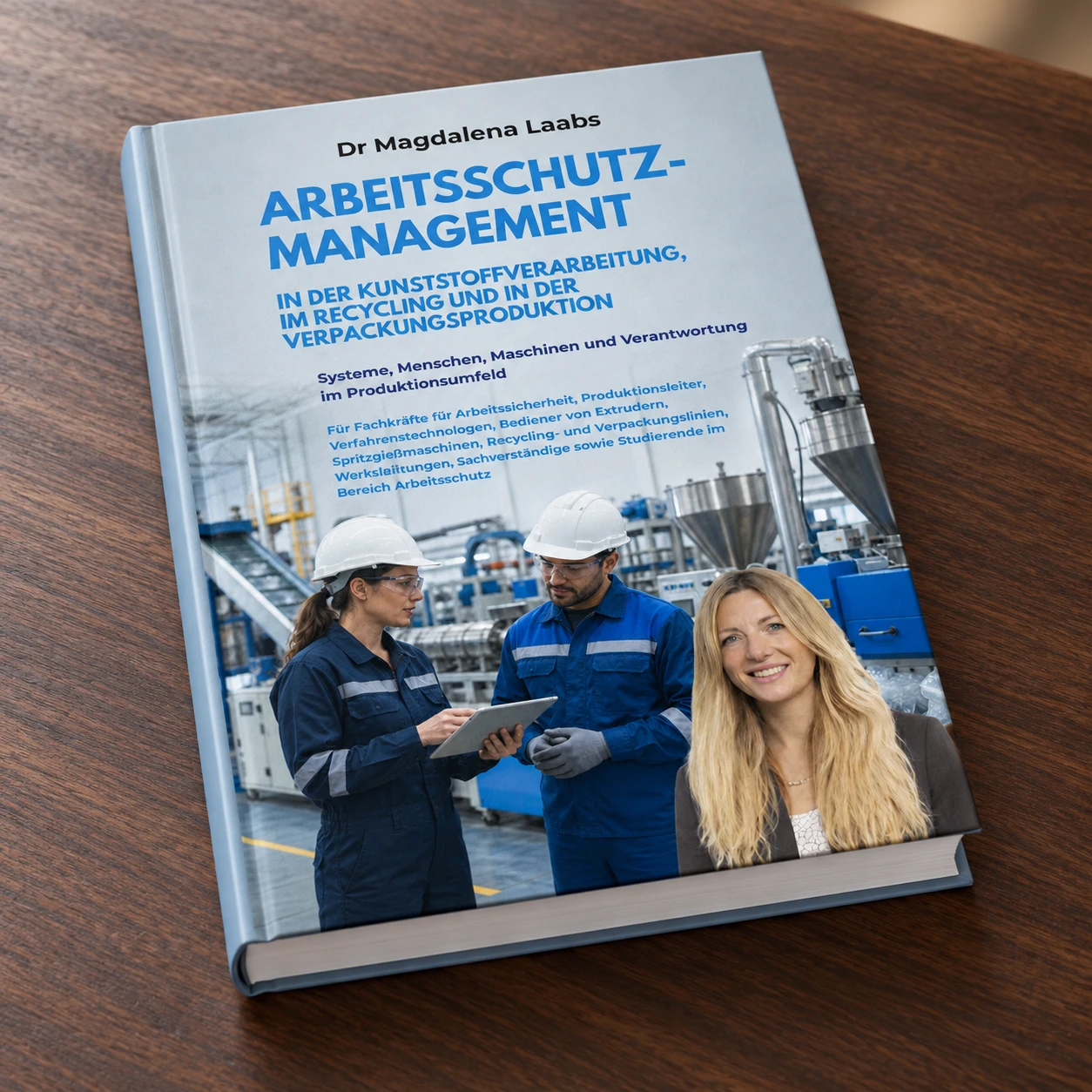
German language · German regulations
The book discusses occupational safety in the context of plastics processing and recycling plants. It shows the connections between materials, machines, work organisation and management responsibilities. It helps analyse risks and plan preventive measures.
A German-language edition on organising occupational health and safety in plants in Germany.
The legal scope depends on the selected edition. The Polish version for Poland covers Polish regulations. Editions for plants in Germany concern German regulations, regardless of the book's language.
We are preparing second editions of books by Dr Magdalena Laabs. Select the title that interests you and request a message when its print version becomes available.
A reference guide for HR departments and those responsible for developing production teams. It explains the specific features of roles, recruitment and employee onboarding in plastics processing and recycling. It connects staffing needs with the actual requirements of production work.
A book for HR departments and those responsible for employees in plastics processing plants.
The second print edition is in preparation. Select the notification option if you would like a message when it is published.
A book about the division of tasks and responsibilities in a film production plant. It supports communication between production, process engineering, quality control, maintenance, HR, sales and the board. It helps establish who makes decisions, what information they should receive and when a problem should be reported.
A practical reference guide for blown film production plants. It covers team roles and responsibilities, raw materials, quality, operator onboarding, and tables and checklists for use in the company.
You can enquire about the e-book or request notification of the new print edition.
The e-book is available. The second print edition is in preparation; you can select a notification request.
Open the catalogue on Payhip and choose a free excerpt. You can also select the book in your enquiry and ask us for a link.

Founder of Rolbatch Academy and President of the Management Board of Rolbatch Engineering GmbH and Rolbatch Sp. z o.o. She has worked in the plastics industry for over 20 years, with experience in implementation, machine selection and solving production problems.
In her training materials, she combines knowledge of raw materials, equipment and process parameters with industrial practice. Rolbatch Academy develops team skills, while Rolbatch Engineering supports companies with technical, investment and implementation consulting.

Association of Polish Mechanical Engineers and Technicians.
109: Materials engineering.
215: Plastics machinery and processing.
In addition to courses and publications, we offer paid technical, investment and implementation consulting.
Analysis of the causes of production problems, parameter optimisation, and support during start-up and process stabilisation.
Technology and equipment selection, comparison of supplier offers, technical audits, and support for trials, acceptance procedures and commissioning.
Support for projects involving secondary raw material preparation, regranulation and the use of in-house production waste.
We agree the scope of cooperation for the specific plant and problem. Detailed information and consulting contact details are available on the Rolbatch Engineering website.
Explore consulting servicesKonferencja Foliowa and Konferencja Recyklingowa are industry meetings at the Sound Garden Hotel in Warsaw for film and packaging manufacturers, recycling companies, and suppliers of raw materials and technologies. Their programme includes presentations and discussions on technology, the market and regulatory changes, as well as opportunities to make business contacts.
To learn more about the conferences or arrange a short meeting with us during an event, please contact us.
Select the courses and books that interest you. We will prepare one message with the full list. You can request an offer, an excerpt link or notification of a new edition.
Check the content before sending. For a long message, you can copy the text and paste it into your email application or WhatsApp.
The data controller is Rolbatch Sp. z o.o. We will receive the enquiry data after the message is sent. Personal data and contact.