
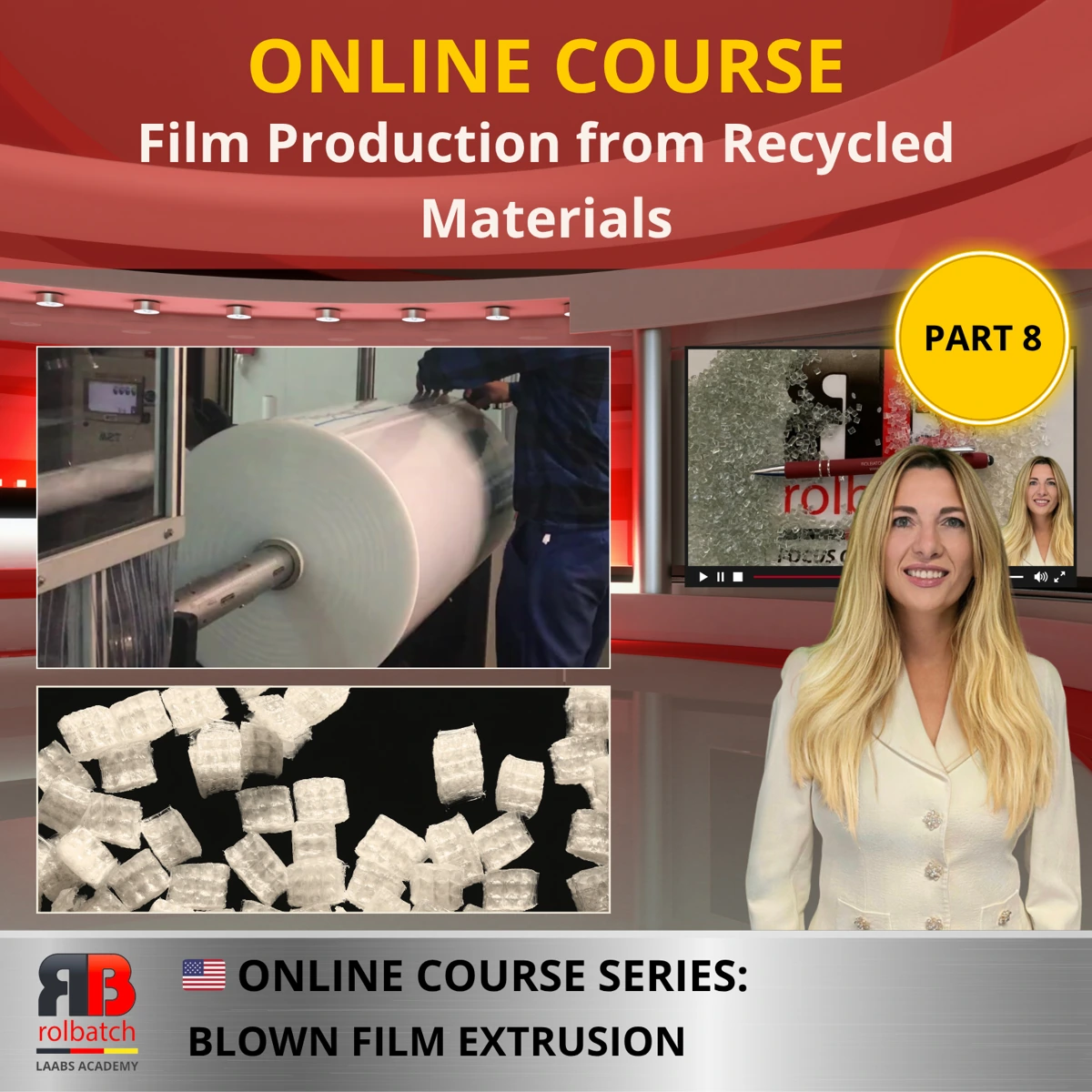
Film production from recycled raw materials and recycling in-house films
Assessing the suitability of regranulates and regrind, preparing blends and working with raw material variability. Reusing in-house production waste in film production.
You can add other courses, Executive and books to one enquiry.
Detailed programme description
Expand the full course descriptionCollapse the full description
Film production from recycled raw materials and recycling in-house films
The course discusses the use of regranulates and regrind in film production and the recovery of in-house production waste. It explains the importance of raw material origin, variability and preparation for processing.
The material covers problems related to contamination, changes in flow properties, colour and film consistency. Participants learn to assess the impact of recycled raw material on the formulation, settings and quality control.
Skills developed in the course
- Understand how regrind and regranulate differ from virgin PE resin: in melt behaviour, contamination levels, moisture content and batch-to-batch variability
- Assess regrind quality before it enters the extruder: MFI, moisture, contamination and homogeneity, and learn which parameters matter most for film extrusion
- Distinguish between post-industrial (PIR) and post-consumer (PCR) regranulate and understand why the source determines what you can and cannot produce
- Set the right blend ratio of regrind to virgin raw material: balancing cost savings with process stability and film quality
- Adjust blown film extrusion line process parameters (temperature, screw speed and pressure) specifically for processing recycled materials
- Recognise how regrind affects film bubble stability and why problems with regranulate often look like machine faults when the real cause is material variability
- Understand how regranulate content affects film properties: mechanical strength, optical clarity and surface quality, and which trade-offs are acceptable for your application
- Apply the principles of design for recycling: designing film structures that enable effective recycling after use, closing the loop from production to the product's end of life
- Implement quality control systems that ensure production repeatability despite variable incoming raw material
Who is this course for?
- Machine operators working with regranulate every day who need to understand why the process behaves differently with each new batch of recycled material
- Production engineers and process engineers responsible for setting blend ratios, adjusting process parameters and maintaining film quality when using regranulate in blown film production
- Quality specialistswho need to assess incoming regranulate quality and connect material properties with final film performance
- Production managers and plant directors under pressure to increase regranulate content while maintaining product quality and production efficiency
- Companies implementing internal recycling programmes or increasing their use of post-consumer and post-industrial PE regranulates
Detailed topic coverage
How regranulate differs from virgin PE resin Fundamental differences in melt behaviour, contamination, thermal history and variability, and why treating regranulate like virgin material causes problems on a blown film extrusion line.
Sources of regranulate: PIR versus PCR How the origin of regranulate affects its quality, consistency and suitability for blown film extrusion, and why post-consumer regranulate requires a completely different approach from post-production regrind.
Assessing regrind quality: key parameters Melt flow index (MFI), moisture content, contamination levels and homogeneity: how to assess the raw material before introducing it to the blown film extrusion line.
Material variability and its impact on process stability How differences between regrind batches translate into process fluctuations, and how to recognise whether instability comes from the material, machine or settings.
Establishing the right blend ratio How to determine the optimum proportion of regrind to virgin raw material: balancing cost, quality and process stability without exceeding the capabilities of the blown film extrusion line.
Adjusting process parameters for regranulates Which temperature, screw speed and pressure settings need to change when processing regrind, and why standard settings for virgin raw material do not work.
The impact of regrind on film bubble stability and film formation Why blown film extrusion with regranulate presents specific challenges: melt inhomogeneity, frost line shifts and thickness variations, and how to address them.
Properties of film containing regranulate How regranulate affects mechanical strength, optical properties, surface quality and sealability, and what level of change is acceptable for different applications.
Design for recycling: closing the loop How to design blown film structures that can be effectively recycled at the end of their life: material and additive selection, and structural simplification.
Quality control in production with regrind Methods for monitoring the quality of raw material and finished film, and how to maintain production repeatability as the raw material changes.
Course format
- Practical PDF materials covering regrind assessment, blend design, process adjustment and quality control in film extrusion with regranulate
- Video and audio explanations for selected topics: material variability, film bubble behaviour with regrind content and quality monitoring
- Final quiz assessing the ability to evaluate regranulate quality, establish blend ratios and maintain process stability
A Rolbatch Academy certificate of participation and the opportunity to earn a diploma after a knowledge assessment. The requirements are explained in the FAQ.
Recycling is more than a sustainability objective. It is a production skill.
Parts 1-7 give your team a complete foundation in blown film extrusion: process, materials, machines, optimisation, supporting technologies, specialist films and multilayer structures. Part 8 enables working with variable raw material: a skill that is becoming increasingly important as industry requirements for regranulate content grow.
Learning arrangements and ordering
The course includes PDF materials and video and audio explanations of selected topics. Participants work at their own pace and can revisit the materials during the access period. Completion, certificate and diploma requirements are explained in the FAQ.
Please include the number of participants, language and preferred date in your enquiry. We will confirm availability, the access period and terms for your team. We accept orders by email. You can combine selected parts, Executive and books in one enquiry.
What does this part cover?
- Assessing the suitability of regranulates and regrind for film production.
- Preparing blends and working with batch variability.
- Reusing in-house production waste.
- Relationships between recycled raw material, the process and film quality.
When should you choose this course?
Choose this part when production uses regranulate or regrind and a better understanding of their impact on product stability and consistency is needed.
How do you use the materials?
You learn online and revisit selected topics during the access period. You can choose the course on its own or combine it with other parts of the programme. In the offer, we will confirm the language, activation date, access period and terms for the selected number of participants.
Course knowledge should be applied with reference to the documentation, equipment and working rules of the specific plant.
Course language
Operator courses, Parts 1-9, are available in Polish, English, German and Spanish. The Executive programme is currently available in English only. We prepare other languages, including Italian and Russian, on request. For orders of at least 10 licences for the same course for 10 people, translation into an additional language is included at no extra charge. An additional translation charge applies to smaller groups. We will confirm the preparation timeframe in the offer.
Specify the language in your enquiry